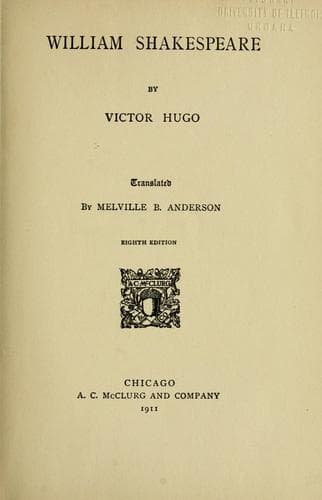
Dramatists, English -- Early modern, 1500-1700 -- Biography; Shakespeare, William, 1564-1616; Stratford-upon-Avon (England) -- Biography
Do you take the Cid for an imitation of Ajax? Do you take Charlemagne
for a plagiary of Agamemnon? "There is nothing new under the sun."
"Your novelty is the repetition of the old," etc. Oh, the strange
process of criticism! Then art is but a series of counterfeits!
Thersites has a thief, Falstaff. Orestes has an imitator, Hamlet. The
Hippogriff is the jay of Pegasus. All these poets! A crew of cheats!
They pillage each other, _voilà tout!_ Inspiration and swindling
compounded. Cervantes plunders Apuleius; Alcestes cheats Timon of
Athens. The Smynthean wood is the forest of Bondy. Out of which pocket
comes the hand of Shakespeare? Out of the pocket of Æschylus.
No! neither decline, nor revival, nor plagiary, nor repetition, nor
imitation: identity of heart, difference of mind,--that is all. Each
great artist (we have said so already) appropriates; stamps art anew
after his own image. Hamlet is Orestes after the effigy of Shakespeare.
Figaro is Scapin, with the effigy of Beaumarchais. Grangousier is
Silenus, after the effigy of Rabelais.
Everything re-begins with the new poet, and at the same time nothing
is interrupted. Each new genius is abyss, yet there is tradition.
Tradition from abyss to abyss,--such is, in art as in the firmament,
the mystery; and men of genius communicate by their effluvia, like the
stars. What have they in common? Nothing,--everything.
From that pit that is called Ezekiel to that precipice that is called
Juvenal, there is no solution of continuity for the thinker. Lean over
this anathema, or over that satire, and the same vertigo is whirling
around both.
The Apocalypse reverberates on the polar sea of ice, and you have that
aurora borealis, the Niebelungen. The Edda replies to the Vedas.
Hence this, our starting-point, to which we are returning: art is not
perfectible.
No possible decline for poetry, no possible improvement. We lose our
time when we say, "Nescio quid majus nascitur Iliade." Art is subject
neither to diminution nor enlarging. Art has its seasons, its clouds,
its eclipses, even its stains, which are splendours, perhaps its
interpositions of sudden opacity for which it is not responsible; but
at the end it is always with the same intensity that it brings light
into the human soul. It remains the same furnace giving the same
brilliancy. Homer does not grow cold.
Let us insist, moreover, on this, inasmuch as the emulation of minds is
the life of the beautiful, O poets, the first rank is ever free. Let
us remove everything which may disconcert daring minds and break their
wings: art is a species of valour. To deny that men of genius yet to
come may be peers with men of genius of the past would be to deny the
ever-working power of God.
Yes, and often do we return, and shall return again, to this necessary
encouragement. Emulation is almost creation. Yes, those men of genius
that cannot be surpassed may be equalled.
How?
By being different.
BOOK IV.
THE ANCIENT SHAKESPEARE.
CHAPTER I.
Public-domain text, read in full here on John Shaqi.
Reviews
Reviews
No reviews yet
Be the first to share your thoughts on this work.
Elsewhere in the archive
Join the Discussion
Join the discussion
Sign in to leave a comment or review.
Sign InorCreate an account