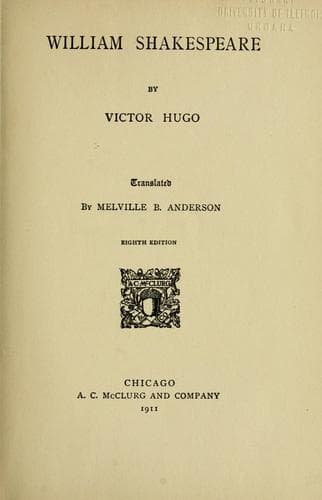
Dramatists, English -- Early modern, 1500-1700 -- Biography; Shakespeare, William, 1564-1616; Stratford-upon-Avon (England) -- Biography
To look at art in the absolute point of view, the characteristic of the
epic poem is grandeur; the characteristic of the drama is immensity.
The immense differs from the great in this, that it excludes, if
it chooses, dimension; that "it is beyond measure," as the common
saying is; and that it can, without losing beauty, lose proportion.
It is harmonious as is the Milky Way. It is by this characteristic of
immensity that the drama commences, four thousand years ago, in Job,
whom we have just named again, and two thousand two hundred years
ago, in Æschylus; it is by this characteristic that it continues in
Shakespeare. What personages does Æschylus take? Volcanoes,--one of
his lost tragedies is called "Etna;" then the mountains,--Caucasus,
with Prometheus; then the sea,--the Ocean on its dragon, and the waves,
the Oceanides; then the vast East,--the Persians; then the bottomless
darkness,--the Eumenides. Æschylus proves the man by the giant. In
Shakespeare the drama approaches nearer to humanity, but remains
colossal. Macbeth seems a polar Atrides. You see that the drama opens
Nature, then opens the soul; there is no limit to this horizon. The
drama is life; and life is everything. The epic poem can be only great;
the drama must necessarily be immense.
This immensity, it is Æschylus throughout, and Shakespeare throughout.
The immense, in Æschylus, is a will. It is also a temperament. Æschylus
invents the buskin which makes the man taller, and the mask which
enlarges the voice. His metaphors are enormous. He calls Xerxes "the
man with the dragon eyes." The sea, which is a plain for so many
poets, is for Æschylus "a forest,"--ἄλσος. These magnifying figures,
peculiar to the highest poets, and to them only, are true; they ace
the true emanations of revery. Æschylus excites you to the very brink
of convulsion. His tragical effects are like blows struck at the
spectators. When the furies of Æschylus make their appearance, pregnant
women miscarry. Pollux, the lexicographer, affirms that there were
children taken with epilepsy and who died, on looking at those faces of
serpents and at those torches violently tossed about. That is evidently
"going beyond the aim." Even the grace of Æschylus, that strange and
sovereign grace of which we have spoken, has a Cyclopean look. It is
Polyphemus smiling. At times the smile is formidable, and seems to hide
an obscure rage. Put, by way of example, in the presence of Helen,
those two poets, Homer and Æschylus. Homer is at once conquered and
admires. His admiration is forgiveness. Æschylus is moved, but remains
grave. He calls Helen "fatal flower;" then he adds, "soul as calm as
the tranquil sea." One day Shakespeare will say, "False as the wave."
CHAPTER II.
The theatre is a crucible of civilization. It is a place of human
communion. All its phases require to be studied. It is in the theatre
that the public soul is formed.
Public-domain text, read in full here on John Shaqi.
Reviews
Reviews
No reviews yet
Be the first to share your thoughts on this work.
Elsewhere in the archive
Join the Discussion
Join the discussion
Sign in to leave a comment or review.
Sign InorCreate an account