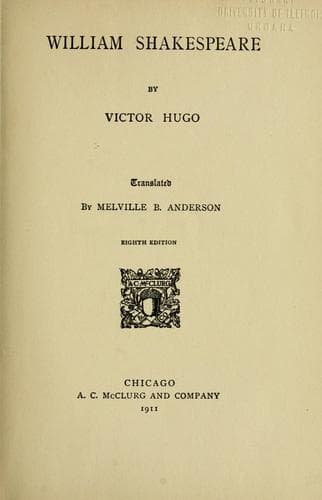
Dramatists, English -- Early modern, 1500-1700 -- Biography; Shakespeare, William, 1564-1616; Stratford-upon-Avon (England) -- Biography
Æschylus is the ancient Shakespeare. Let us return to Æschylus. He is
the grandsire of the stage.
This book would be incomplete if Æschylus had not his separate place in
it.
A man whom we do not know how to class in his own century, so little
does he belong to it, being at the same time so much behind it and so
much in advance of it, the Marquis de Mirabeau, that queer customer as
a philanthropist, but a very rare thinker after all, had a library,
in the two comers of which he had had carved a dog and a she-goat, in
remembrance of Socrates, who swore by the dog, and of Zeno, who swore
by the goat. His library presented this peculiarity: on one side he had
Hesiod, Sophocles, Euripides, Plato, Herodotus, Thucydides, Pindar,
Theocritus, Anacreon, Theophrastus, Demosthenes, Plutarch, Cicero Titus
Livius, Seneca, Persius, Lucan, Terence, Horace, Ovid, Propertius,
Tibullus, Virgil, and underneath could be read, engraved in letters of
gold, "Amo;" on the other side, he had Æschylus alone, and underneath,
this word, "Timeo."
Æschylus, in reality, is formidable. He cannot be approached without
trembling. He has magnitude and mystery. Barbarous, extravagant,
emphatic, antithetical, bombastic, absurd,--such is the judgment passed
on him by the official rhetoric of the present day. This rhetoric will
be changed. Æschylus is one of those men whom superficial criticism
scoffs at or disdains, but whom the true critic approaches with a sort
of sacred fear. The dread of genius is the first step toward taste.
In the true critic there is always a poet, even when in a latent state.
Whoever does not comprehend Æschylus is irremediably an ordinary mind.
Intellects may be tried on Æschylus.
The Drama is a strange form of art. Its diameter measures from the
"Seven against Thebes" to the "Philosopher Without Knowing it," and
from Brid'oison to Œdipus. Thyestes forms part of it, Turcaret also.
If you wish to define it, put into your definition Electra and Marton.
The drama is disconcerting. It baffles the weak. This comes from
its ubiquity. The drama has every horizon. You may then imagine its
capacity. The epic poem has been blended in the drama, and the result
is this marvellous literary novelty, which is at the same time a social
power,--the romance.
Bronze, amalgamation of the epic, lyric, and dramatic,--such is the
romance. "Don Quixote" is iliad, ode, and comedy.
Such is the expansion possible to the drama.
The drama is the largest recipient of art. God and Satan are there;
witness Job.
Public-domain text, read in full here on John Shaqi.
Reviews
Reviews
No reviews yet
Be the first to share your thoughts on this work.
Elsewhere in the archive
Join the Discussion
Join the discussion
Sign in to leave a comment or review.
Sign InorCreate an account