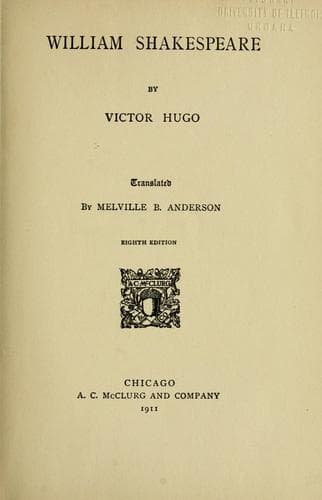
Dramatists, English -- Early modern, 1500-1700 -- Biography; Shakespeare, William, 1564-1616; Stratford-upon-Avon (England) -- Biography
There are not only the students to make a row; there are the old men.
Trust to the old men of the "Wasps" of Aristophanes for a noise. Two
schools are in presence,--on one side Thespis, Susarion, Pratinas of
Phlius, Epigenes of Sicyon, Theomis, Auleas, Chœrilus, Phrynichus,
Minos himself; on the other, young Æschylus. Æschylus is twenty-eight
years old. He gives his trilogy of the "Promethei,"--"Prometheus
Lighting Fire;" "Prometheus Bound;" "Prometheus Delivered," followed by
some piece with satyrs,--"The Argians," perhaps, of which Macrobius has
preserved a fragment for us. The ancient quarrel of youth and old age
breaks out; gray beards against black hair. They discuss, they dispute.
The old are for the old school; the young are for Æschylus. The young
defend Æschylus against Thespis, as they will defend Corneille against
Garnier.
The old men are indignant. Listen to the Nestors grumbling. What
is tragedy? It is the song of the he-goat. Where is the he-goat in
this "Prometheus Bound"? Art is in its decline. And they repeat the
celebrated objection: "Quid pro Baccho?" (What is there for Bacchus?)
The graver men, the purists, do not even admit Thespis, and remind
each other that Solon had raised his stick against Thespis, calling
him "liar," for the sole reason that he had detached and isolated in
a play an episode in the life of Bacchus,--the history of Pentheus.
They hate this innovator, Æschylus. They blame all these inventions,
the end of which is to bring about a closer connection between the
drama and Nature, the use of the anapæst for the chorus, of the iambus
for the dialogue, and of the trochee for passion, in the same way
that, later on, Shakespeare was blamed for going from poetry to prose,
and the theatre of the nineteenth century for that which was termed
"broken verse." These are indeed unbearable novelties. And then, the
flute plays too high, and the tetrachord plays too low; and where is
now the ancient sacred division of tragedies into monodies, stasimes,
and exodes? Thespis never put on the stage but one speaking actor;
here is Æschylus putting two. Soon we shall have three. (Sophocles,
indeed, was to come.) Where will they stop? These are impieties.
And how does Æschylus dare to call Jupiter "the prytanus of the
Immortals?" Jupiter was a god, and he is now no more than a magistrate.
Where are we going? The thymele, the ancient altar of sacrifice, is
now a seat for the corypheus! The chorus ought to limit itself to
executing the strophe,--that is to say, the turn to the right; then
the antistrophe,--that is to say, the turn to the left; then the
epode,--that is to say, repose. But what is the meaning of the chorus
arriving in a winged chariot? What is the gad-fly that pursues Io? Why
does the Ocean come mounted on a dragon? This is show, not poetry.
Where is the ancient simplicity? This show is puerile. Your Æschylus
is but a painter, a decorator, a composer of brawls, a charlatan, a
machinist.
Public-domain text, read in full here on John Shaqi.
Reviews
Reviews
No reviews yet
Be the first to share your thoughts on this work.
Elsewhere in the archive
Join the Discussion
Join the discussion
Sign in to leave a comment or review.
Sign InorCreate an account