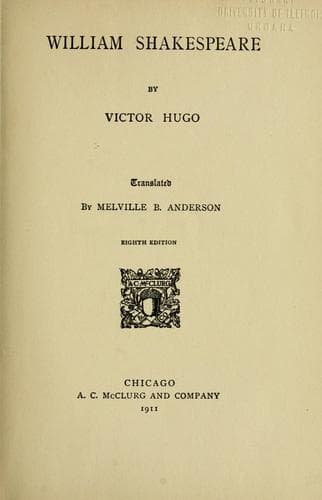
Dramatists, English -- Early modern, 1500-1700 -- Biography; Shakespeare, William, 1564-1616; Stratford-upon-Avon (England) -- Biography
All for the eyes, nothing for the mind. To the fire with
all those pieces, and let us content ourselves with a recitation of
the ancient pæans of Tynnichus! It is Chœrilus who, by his tetralogy
of the "Curetes," has begun the evil. What are the Curetes, if you
please? Gods forging metal. Well, then, he had simply to show working
on the stage their five families, the Dactyli finding the metal, the
Cabiri inventing the forge, the Corybantes forging the sword and
the plough-share, the Curetes making the shield, and the Telchines
chasing the jewelry. It was sufficiently interesting in that form;
but by allowing poets to blend in it the adventure of Plexippus and
Toxeus, all is lost. How can you expect society to resist such excess?
It is abominable. Æschylus ought to be summoned before justice, and
sentenced to drink hemlock like that old wretch Socrates. You will see
that after all, he will only be exiled. Everything degenerates.
And the young men burst with laughter. They criticise as well, but in
another fashion. What an old brute is that Solon! It is he who has
instituted the eponymous archonship. What do they want with an archon
giving his name to the year? Hoot the eponymous archon who has lately
caused a poet to be elected and crowned by ten generals, instead of
taking ten men from the people! It is true that one of the generals
was Cimon,--an attenuating circumstance in the eyes of some, for Cimon
had beaten the Phœnicians; aggravating in the eyes of others, for
it is this very Cimon who, in order to get out of a prison for debt,
sold his sister Elphinia, and his wife in the bargain, to Callias. If
Æschylus is a bold man, and deserves to be cited before the Areopagus,
has not Phrynichus also been judged and condemned for having shown
on the stage, in the "Taking of Miletus," the Greeks beaten by the
Persians? When will poets be allowed to suit their own fancy? Hurrah
for the liberty of Pericles and down with the censure of Solon! And
then what is the law that has just been promulgated by which the
chorus is reduced from fifty to fifteen? And how are they to play the
"Danaïdes"? and won't they sneer at the line of Æschylus: "Egyptus, the
father of _fifty_ sons"? The fifty will be fifteen. These magistrates
are idiots. Quarrel, uproar all round. One prefers Phrynichus, another
prefers Æschylus, another prefers wine with honey and benzoin. The
speaking-trumpets of the actors compete as well as they can with this
deafening noise, through which is heard from time to time the shrill
cry of the public vendors of phallus and the water-bearers. Such is
Athenian uproar. During that time the play is going on. It is the work
of a living man. The uproar has every reason to be. Later on, after the
death of Æschylus, or after he has been exiled, there will be silence.
It is right to be silent before a god. "Æquum est," it is Plautus who
speaks, "vos deo facere silentium."
[Footnote 1: Αρχηαιομελεσιδονοπηρυνιχηερατα.]
CHAPTER III.
Public-domain text, read in full here on John Shaqi.
Reviews
Reviews
No reviews yet
Be the first to share your thoughts on this work.
Elsewhere in the archive
Join the Discussion
Join the discussion
Sign in to leave a comment or review.
Sign InorCreate an account