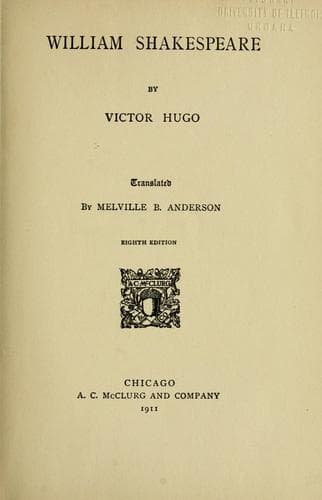
Dramatists, English -- Early modern, 1500-1700 -- Biography; Shakespeare, William, 1564-1616; Stratford-upon-Avon (England) -- Biography
A genius is an accused man. As long as Æschylus lived, his life was a
strife. His genius was contested, then he was persecuted,--a natural
progression. According to Athenian practice, his private life was
unveiled; he was traduced, slandered. A woman whom he had loved,
Planesia, sister of Chrysilla, mistress of Pericles, has dishonoured
herself in the eyes of posterity by the outrages that she publicly
inflicted on Æschylus. People ascribed to him unnatural loves; people
gave him, as well as Shakespeare, a Lord Southampton. His popularity
was knocked to pieces. Then everything was charged to him as a crime,
even his kindness to young poets, who respectfully offered to him
their first laurels. It is curious to see this reproach constantly
re-appearing. Pezay and St. Lambert repeat it in the eighteenth
century:--
"Pourquoi, Voltaire, à ces auteurs
Qui t'adressent des vers flatteurs,
Répondre, en toutes tes missives,
Par des louanges excessives?"
Æschylus, living, was a kind of public target for all haters. Young,
the ancient poets, Thespis and Phrynichus, were preferred to him. Old,
the new ones, Sophocles and Euripides, were placed above him. At last
he was brought before the Areopagus, and, according to Suidas, because
the theatre tumbled down during one of his pieces; according to Ælian,
because he had blasphemed, or, which is the same thing, had related
the mysteries of Eleusis, he was exiled. He died in exile.
Then Lycurgus the orator cried, "We must raise a statue of bronze to
Æschylus."
Athens had expelled the man, but raised the statue.
Thus Shakespeare, through death, entered into oblivion; Æschylus into
glory.
This glory, which was to have in the course of ages its phases, its
eclipses, its ebbing and rising tides, was then dazzling. Greece
remembered Salamis, where Æschylus had fought. The Areopagus itself
was ashamed. It felt that it had been ungrateful toward the man who,
in the "Orestias," had paid to that tribunal the supreme honour of
bringing before it Minerva and Apollo. Æschylus became, sacred. All
the phratries had his bust, wreathed at first with bandolets, later on
crowned with laurels. Aristophanes made him say in the "Frogs": "I am
dead, but my poetry liveth." In the great Eleusinian days, the herald
of the Areopagus blew the Tyrrhenian trumpet in honour of Æschylus.
An official copy of his ninety-seven dramas was made at the expense
of the republic, and placed under the special care of the recorder of
Athens. The actors who played his pieces were obliged to go and collate
their parts by this perfect and unique copy. Æschylus was made a second
Homer. Æschylus had, likewise, his rhapsodists, who sang his verses at
the festivals, holding in their hands a branch of myrtle.
He had been right, the great and insulted man, to write on his poems
this proud and mournful dedication, "To Time."
Public-domain text, read in full here on John Shaqi.
Reviews
Reviews
No reviews yet
Be the first to share your thoughts on this work.
Elsewhere in the archive
Join the Discussion
Join the discussion
Sign in to leave a comment or review.
Sign InorCreate an account