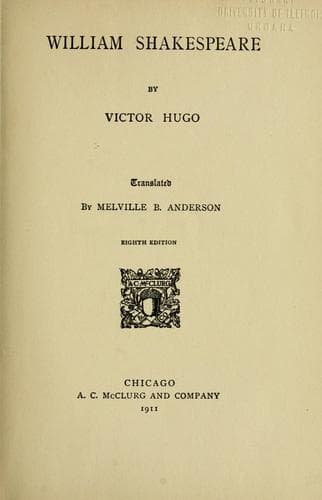
Dramatists, English -- Early modern, 1500-1700 -- Biography; Shakespeare, William, 1564-1616; Stratford-upon-Avon (England) -- Biography
Particular care was taken of this manuscript when the library of
Alexandria, enlarged by the library of Pergamus, which Antony gave to
Cleopatra, was transferred to the temple of Jupiter Serapis. There it
was that Saint Jerome came to read, in the Athenian text, the famous
passage in "Prometheus" prophesying Christ: "Go and tell Jupiter that
nothing shall make me name the one who is to dethrone him."
Other doctors of the Church made, from the same copy, the same
verification. For, at all times, the orthodox asseverations have been
combined with what have been called the testimonies of polytheism,
and great efforts have been resorted to in order to make the
Pagans say Christian things,--_teste David cum Sibylla._ People
came to the Alexandrian library, as on a pilgrimage, to examine
"Prometheus,"--constant visits which deceived the Emperor Adrian, and
made him write to the consul Servianus: "Those who adore Serapis are
Christians: those who profess to be bishops of Christ are at the same
time devotees of Serapis."
Under the Roman dominion the library of Alexandria belonged to
the emperor. Egypt was Cæsar's property. "Augustus," says Tacitus,
"seposuit Ægyptum." It was not every one who could travel there. Egypt
was closed. The Roman knights, and even the senators, could not easily
obtain admission.
It was during this period that the complete copy of Æschylus could be
consulted and perused by Timocharis, Aristarchus, Athenæus, Stobæus,
Diodorus of Sicily, Macrobius, Plotinus, Jamblichus, Sopater, Clement
of Alexandria, Nepotian of Africa, Valerius Maximus, Justin the Martyr,
and even by Ælian, although Ælian left Italy but seldom.
In the seventh century a man entered Alexandria. He was mounted on
a camel and seated between two sacks,--one full of figs, the other
full of corn. These two sacks were, with a wooden platter, all that
he possessed. This man never seated himself except on the ground. He
drank nothing but water and ate nothing but bread. He had conquered
half of Asia and of Africa, taken or burned thirty-six thousand towns,
villages, fortresses, and castles, destroyed four thousand Pagan or
Christian temples, built fourteen hundred mosques, conquered Izdeger,
King of Persia, and Heraclius, Emperor of the East, and he called
himself Omar. He burned the library of Alexandria.
Omar is for that reason celebrated. Louis, called the Great, has not
the same celebrity, which is unjust, for he burned the Rupertine
library at Heidelberg.
[Illustration] _Anne Hathaway's Cottage._
Photogravure.--From Photograph.
CHAPTER V.
Now, is not that incident a complete drama? It might be entitled
"Æschylus Lost." Recital, node, and _dénouement._ After Euergetes,
Omar. The action begins with a robber and ends with an incendiary.
Euergetes (this is his excuse) robbed from enthusiasm,--an unpleasant
instance of the admiration of an imbecile.
Public-domain text, read in full here on John Shaqi.
Reviews
Reviews
No reviews yet
Be the first to share your thoughts on this work.
Elsewhere in the archive
Join the Discussion
Join the discussion
Sign in to leave a comment or review.
Sign InorCreate an account