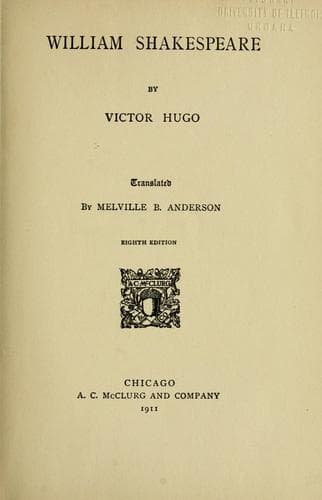
Dramatists, English -- Early modern, 1500-1700 -- Biography; Shakespeare, William, 1564-1616; Stratford-upon-Avon (England) -- Biography
Euergetes, through his wish for exclusive possession, and treating a
library as a seraglio, has robbed us of Æschylus. Imbecile contempt can
have the same effect as imbecile adoration. Shakespeare was very near
having the fate of Æschylus. He has had, too, his fire. Shakespeare
was so little printed, printing existed so little for him, thanks to
the silly indifference of his immediate posterity, that in 1666 there
was still but one edition of the poet of Stratford-on-Avon (Hemynge
and Condell's edition), three hundred copies of which were printed.
Shakespeare, with this obscure and pitiful edition, waiting in vain for
the public, was a sort of poor wretch ashamed to beg for glory. These
three hundred copies were nearly all stored up in London when the fire
of 1666 broke out. It burned London, and nearly burned Shakespeare. The
whole edition of Hemynge and Condell disappeared, with the exception of
forty-four copies, which had been sold in fifty years. Those forty-four
purchasers saved from death the work of Shakespeare.
CHAPTER VI.
The disappearance of Æschylus! Stretch this catastrophe hypothetically
to a few more names, and it seems as though you felt the vacuum
annihilating the human mind.
The work of Æschylus was, by its extent, the greatest, certainly, of
all antiquity. By the seven plays which remain to us, we may judge what
that universe was.
Let us point out what Æschylus lost is.
Fourteen trilogies: the "Promethei," of which "Prometheus Bound" formed
a part; the "Seven Chiefs before Thebes," of which there remains
one piece, "The Danaid," which comprised the "Supplicants," written
in Sicily, and in which the _Sicelism_ of Æschylus is traceable;
"Laius," which comprised "Œdipus;" "Athamas," which ended with the
"Isthmiasts;" "Perseus," the node of which was the "Phorcydes;" "Etna,"
which had as prologue the "Etnean Women;" "Iphigenia," the _dénouement_
of which was the tragedy of the "Priestesses;" the "Ethiopid," the
titles of which are nowhere to be found; "Pentheus," in which were the
"Hydrophores;" "Teucer," which opened with the "Judgment of Arms;"
"Niobe," which commenced with the "Nurses" and ended with the "Men
of the Train;" a trilogy in honour of Achilles, the "Tragic Iliad,"
composed of the "Myridons," the "Nereids," and the "Phrygians;" one
in honour of Bacchus, the "Lycurgia," composed of the "Edons," the
"Bassarides," and the "Young Men."
These fourteen trilogies in themselves alone give a total of fifty-six
plays, if we consider that nearly all were tetralogies,--that is to
say, quadruple dramas,--and ended with a satyride. Thus the "Orestias"
had, as a final satyride, "Proteus," and the "Seven Chiefs before
Thebes," had the "Sphinx."
Public-domain text, read in full here on John Shaqi.
Reviews
Reviews
No reviews yet
Be the first to share your thoughts on this work.
Elsewhere in the archive
Join the Discussion
Join the discussion
Sign in to leave a comment or review.
Sign InorCreate an account