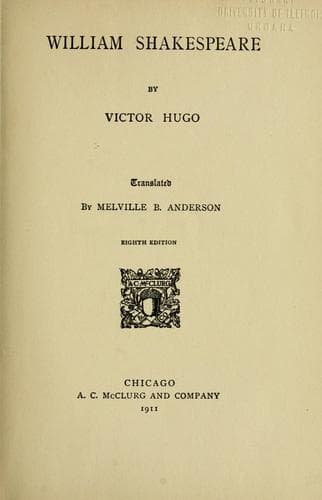
Dramatists, English -- Early modern, 1500-1700 -- Biography; Shakespeare, William, 1564-1616; Stratford-upon-Avon (England) -- Biography
Saumaise declares that he is full of Hebraisms and Syrianisms.[1]
Æschylus makes the Winds carry Jupiter's throne, as the Bible makes
the Cherubim carry Jehovah's throne, as the Rig-Veda makes the Marouts
carry the throne of Indra. The winds, the cherubim, and the marouts are
the same beings,--the Breezes. Saumaise is right. The double-meaning
words so frequent in the Phœnician language, abound in Æschylus.
He plays, for instance, in reference to Jupiter and Europa, on the
Phœnician word _ilpha_, which has the double meaning of "ship" and
"bull." He loves that language of Tyre and Sidon, and at times he
borrows the strange gleams of its style; the metaphor, "Xerxes with
the dragon eyes," seems an inspiration from the Ninevite dialect, in
which the word _draka_ meant at the same time dragon and clear-sighted.
He has Phœnician heresies. His heifer Io is rather the cow of Isis;
he believes, like the priests of Sidon, that the temple of Delphi was
built by Apollo with a paste made of wax and bees'-wings. In his exile
in Sicily he often drank religiously at the fountain of Arethusa,
and never did the shepherds who watched him hear him name Arethusa
otherwise than by this mysterious name, _Alphaga_,--an Assyrian word
signifying "source surrounded with willows."
Æschylus is, in the whole Hellenic literature, the sole example of
the Athenian mind with a mixture of Egypt and Asia. These depths were
repugnant to the Greek intelligence. Corinth, Epidaurus, Œdepsus,
Gythium, Cheronea, which was to be the birth-place of Plutarch, Thebes,
where Pindar's house was, Mantinea, where the glory of Epaminondas
shone,--all these golden towns repudiated the Unknown, a glimpse of
which was seen like a cloud behind the Caucasus. It seemed as though
the sun was Greek. The sun, used to the Parthenon, was not made
to enter the diluvian forests of Grand Tartary under the gigantic
mouldiness of the monocotyledons under the lofty ferns of five hundred
cubits, where swarmed all the first dreadful models of Nature, and
under whose shadows existed unknown, shapeless cities, such as that
fabulous Anarodgurro, the existence of which was denied until it sent
an embassy to Claudius. Gagasmira, Sambulaca, Maliarpha, Barygaza,
Cavenpatnam Sochoth-Benoth, Theglath-Phalazar, Tana-Serim--all these
almost hideous names affrighted Greece when they came to be reported
by the adventurers on their return first by those with Jason, then by
those of Alexander. Æschylus had no such horror. He loved the Caucasus.
It was there he had made the acquaintance of Prometheus. One almost
feels in reading Æschylus that he had haunted the vast primitive
thickets now become coal mines, and that he has taken huge strides
over the roots, snake-like and half-living, of the ancient vegetable
monsters. Æschylus is a kind of behemoth among geniuses.
Public-domain text, read in full here on John Shaqi.
Reviews
Reviews
No reviews yet
Be the first to share your thoughts on this work.
Elsewhere in the archive
Join the Discussion
Join the discussion
Sign in to leave a comment or review.
Sign InorCreate an account