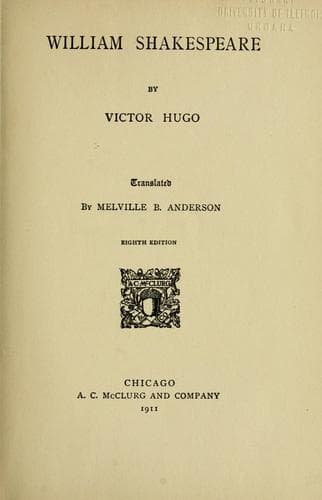
Dramatists, English -- Early modern, 1500-1700 -- Biography; Shakespeare, William, 1564-1616; Stratford-upon-Avon (England) -- Biography
He brings down to dwarfish proportions the Greeks, conquerors of Troy
by treachery; he shows them brought forth by an implement of war,--he
calls them "these young of a horse." As for the gods, he goes so far as
to incorporate Apollo with Jupiter. He magnificently calls Apollo "the
conscience of Jupiter."
His familiar boldness is absolute, characteristic of sovereignty. He
makes the sacrificer take Iphigenia "as a she-goat" A queen who is a
faithful spouse is for him "the good house-bitch." As for Orestes, he
has seen him when quite a child, and he speaks of him as "wetting his
swaddling-cloths,"--_humectatio ex urina._ He even goes beyond this
Latin. The expression, which we do not repeat here, is to be found in
"Les Plaideurs," act III. scene 3. If you are bent upon reading the
word which we hesitate to write, apply to Racine.
The whole is immense and mournful. The profound despair of fate is in
Æschylus. He shows in terrible lines "the impotence which chains down,
as in a dream, the blind living creatures." His tragedy is nothing
but the old Orphean dithyrambic suddenly launching into tears and
lamentations over man.
[Footnote 1: "Hebraïsmis et Syrianismis."]
CHAPTER VIII.
Aristophanes loved Æschylus by that law of affinity which causes
Marivaux to love Racine tragedy and comedy made to understand each
other.
The same distracted and all-powerful breath fills Æschylus and
Aristophanes. They are the two inspired spirits of the antique mask.
Aristophanes, who is not yet judged, adhered to the mysteries, to
Cecropian poetry, to Eleusis, to Dodona, to the Asiatic twilight, to
the profound pensive dream. This dream, whence sprung the art of Egina,
was at the threshold of the Ionian philosophy in Thales as well as
at the threshold of the Italian philosophy in Pythagoras. It was the
sphinx guarding the entrance.
This sphinx has been a muse,--the great pontifical and lascivious
muse of universal rut; and Aristophanes loved it This sphinx breathed
tragedy into Æschylus, and comedy into Aristophanes. It had something
of Cybele. The ancient sacred immodesty is in Aristophanes. At moments
he has Bacchus foaming at the lips. He came from the Dionysia, or from
the Aschosia, or from the great Trieteric Orgy, and he strikes one as a
raving maniac of the mysteries. His wild verse resembles the bassaride
hopping giddily upon bladders filled with air. Aristophanes has the
sacerdotal obscurity. He is for nudity against love. He denounces the
Phedras and Sthenobæas, and he creates Lysistrata.
Public-domain text, read in full here on John Shaqi.
Reviews
Reviews
No reviews yet
Be the first to share your thoughts on this work.
Elsewhere in the archive
Join the Discussion
Join the discussion
Sign in to leave a comment or review.
Sign InorCreate an account