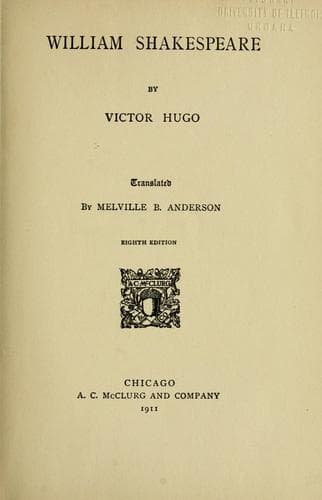
Dramatists, English -- Early modern, 1500-1700 -- Biography; Shakespeare, William, 1564-1616; Stratford-upon-Avon (England) -- Biography
Qualities the most diverse, the most complex, the most opposed in
appearance, enter into the composition of souls. The contraries do
not exclude each other,--far from that; they complete each other.
More than one prophet contains a scholiast; more than one magian
is a philologist. Inspiration knows its own trade. Every poet is a
critic: witness that excellent piece of criticism on the theatre
that Shakespeare puts in the mouth of Hamlet. A visionary mind may
be at the same time precise,--like Dante, who writes a book on
rhetoric, and a grammar. A precise mind may be at the same time
visionary,--like Newton, who comments on the Apocalypse; like Leibnitz,
who demonstrates, _nova inventa logica_, the Holy Trinity. Dante knows
the distinction between the three sorts of words, _parola piana,
parola sdrucciola, parola tronca_; he knows that the _piana_ gives a
trochee, the _sdrucciola_ a dactyl, and the _tronca_ an iambus. Newton
is perfectly sure that the Pope is the Antichrist. Dante combines and
calculates; Newton dreams.
No law is to be grasped in that obscurity. No system is possible. The
currents of adhesions and of cohesions cross each other pell-mell. At
times one imagines that he detects the phenomenon of the transmission
of the idea, and fancies that he distinctly sees a hand taking the
light from him who is departing, to give it to him who arrives. 1642,
for example, is a strange year. Galileo dies, Newton is born, in that
year. Good. It is a thread; try and tie it, it breaks at once. Here is
a disappearance: on the 23d of April, 1616, on the same day, almost
at the same minute, Shakespeare and Cervantes die. Why are these two
flames extinguished at the same moment? No apparent logic. A whirlwind
in the night.
Enigmas constantly. Why does Commodus proceed from Marcus Aurelius?
These problems beset in the desert Jerome, that man of the caves,
that Isaiah of the New Testament He interrupted his deep thoughts on
eternity, and his attention to the trumpet of the archangel, in order
to meditate on the soul of some Pagan in whom he felt interested. He
calculated the age of Persius, connecting that research with some
obscure chance of possible salvation for that poet, dear to the
cenobite on account of his strictness; and nothing is so surprising as
to see this wild thinker, half naked on his straw, like Job, dispute on
this question, so frivolous in appearance, of the birth of a man, with
Rufinus and Theophilus of Alexandria,--Rufinus observing to him that
he is mistaken in his calculations, and that Persius having been born
in December under the consulship of Fabius Persicus and Vitellius, and
having died in November, under the consulship of Publius Marius and
Asinius Gallus, these periods do not correspond rigorously with the
year II. of the two hundred and third Olympiad, and the year II. of
the two hundred and tenth, the dates fixed by Jerome. The mystery thus
attracts deep thinkers.
Public-domain text, read in full here on John Shaqi.
Reviews
Reviews
No reviews yet
Be the first to share your thoughts on this work.
Elsewhere in the archive
Join the Discussion
Join the discussion
Sign in to leave a comment or review.
Sign InorCreate an account