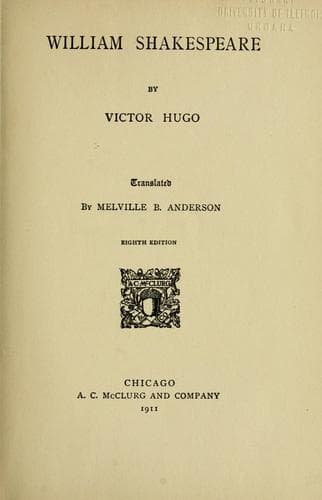
Dramatists, English -- Early modern, 1500-1700 -- Biography; Shakespeare, William, 1564-1616; Stratford-upon-Avon (England) -- Biography
The expanse of the possible is, so to speak, under your eyes. The
dream that you have in yourself, you discover it beyond yourself. All
is indistinct. Confused white shadows are moving. Are they souls? One
catches, in the depths below, a glimpse of vague archangels passing
along; will they be men at some future day? Holding your head between
your hands, you strive to see and to know. You are at the window
looking into the unknown. On all sides the deep layers of effects
and causes, heaped one behind the other, wrap you with mist. The man
who meditates not lives in blindness; the man who meditates lives in
darkness. The choice between darkness and darkness, that is all we
have. In that darkness, which is up to the present time nearly all our
science, experience gropes, observation lies in wait, supposition moves
about If you gaze at it very often, you become _vates._ Vast religious
meditation takes possession of you.
Every man has in him his Patmos. He is free to go or not to go on that
frightful promontory of thought from which darkness is seen. If he
goes not, he remains in the common life, with the common conscience,
with the common virtue, with the common faith, or with the common
doubt; and it is well. For the inward peace it is evidently the best.
If he ascends to that peak, he is caught. The profound waves of the
marvellous have appeared to him. No one sees with impunity that
ocean. Henceforth he will be the thinker enlarged, magnified, but
floating,--that is to say, the dreamer. He will partake of the poet and
of the prophet A certain quantity of him now belongs to darkness. The
boundless enters into his life, into his conscience, into his virtue,
into his philosophy. He becomes extraordinary in the eyes of other men,
for his measure is different from theirs. He has duties which they have
not. He lives in a sort of vague prayer, attaching himself, strangely
enough, to an indefinite certainty which he calls God. He distinguishes
in that twilight enough of the anterior life and enough of the ulterior
life to seize these two ends of the dark thread, and with them to tie
up his soul again. Who has drunk will drink; who has dreamed will
dream. He will not give up that alluring abyss, that sounding of the
fathomless, that indifference for the world and for life, that entrance
into the forbidden, that effort to handle the impalpable and to see the
invisible; he returns to them, he leans and bends over them; he takes
one step forward, then two,--and thus it is that one penetrates into
the impenetrable; and thus it is that one plunges into the boundless
chasms of infinite meditation.
He who walks down them is a Kant; he who falls down them is a
Swedenborg.
Public-domain text, read in full here on John Shaqi.
Reviews
Reviews
No reviews yet
Be the first to share your thoughts on this work.
Elsewhere in the archive
Join the Discussion
Join the discussion
Sign in to leave a comment or review.
Sign InorCreate an account