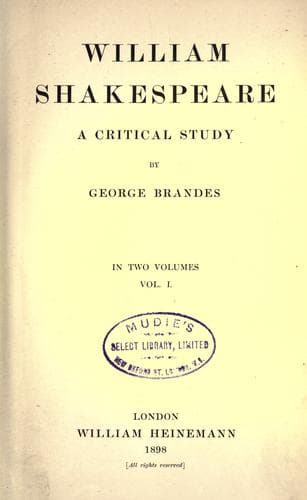
William Shakespeare: A Critical StudyBrandes, Georg
General
William Shakespeare: A Critical Study
Brandes, Georg
Shakespeare, William, 1564-1616 -- Criticism and interpretation
The reversal in the mutual relations of Benedick and Beatrice is,
moreover, highly interesting in so far as it is probably the first
instance of anything like careful character-development which we
have as yet encountered in any single play of Shakespeare's. In the
earlier comedies there was nothing of the kind, and the chronicle-plays
afforded no opportunity for it. The characters had simply to be
brought into harmony with the given historical events, and in every
case Shakespeare held firmly to the character-scheme once laid down.
Neither _Richard III_. nor _Henry V_. presents any spiritual history;
both kings, in the plays which take their names from them, are one and
the same from first to last. Enough has already been said of Henry's
change of front with respect to Falstaff in _Henry IV_.; we need only
remark further that here the old play of _The Famous Victories_[1]
unmistakably pointed the way to Shakespeare. But this melting of all
that is hard and frozen in the natures of Benedick and Beatrice is
without a parallel in any earlier work, and is quite plainly executed
_con amore_. And the real substance of the play lies not in the plot
from which it takes its name, but in the relation between these two
characters, freely invented by Shakespeare,
Some other characters Shakespeare has added, and they are among the
most admirable of his comic creations: the peace-officer Dogberry,
and his subordinate Verges. Dogberry is a country constable, simple
as a child, and vain as a peacock--a well-meaning, timid, honest,
good-natured blockhead. To show that, in those days, such functionaries
were almost as helpless in real life as they are here represented,
Henrik Schück has cited a letter from Elizabeth's Prime Minister, Lord
Burghley, in which he relates how, in 1586, on a journey from London
into the county, he found at the gate of every town ten or twelve
persons armed with long poles. On inquiring, he learned that they
were stationed there to seize three young men, unknown. Asked what
description they had received of the malefactors, they replied that one
of them was said to have a crooked nose. "And have you no other mark to
recognise them by?" "No," was the answer. Moreover, they always stood
so openly in a body, that no criminal could fail to give them a wide
berth.
Dogberry is still less formidable than this detective force. Here are
the wise and wary instructions which he gives to his watchmen:--
"_Dogberry_. If you meet a thief, you may suspect him, by
virtue of your office, to be no true man; and, for such kind
of men, the less you meddle or make with them, why, the more
is for your honesty.
"2 _Watch_. If we know him to be a thief, shall we not lay
hands on him?
"_Dogb_. Truly, by your office you may; but, I think, they
that touch pitch will be defiled. The most peaceable way for
you, if you do take a thief, is, to let him show himself
what he is, and steal out of your company."
Public-domain text, read in full here on John Shaqi.
Reviews
Reviews
No reviews yet
Be the first to share your thoughts on this work.
Elsewhere in the archive
Join the Discussion
Join the discussion
Sign in to leave a comment or review.
Sign InorCreate an account