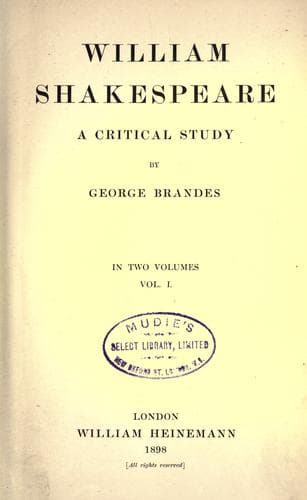
William Shakespeare: A Critical StudyBrandes, Georg
General
William Shakespeare: A Critical Study
Brandes, Georg
Shakespeare, William, 1564-1616 -- Criticism and interpretation
The two cousins, Rosalind and Celia, seem at first glance like
variations of the two cousins, Beatrice and Hero, in the play
Shakespeare has just finished. Rosalind and Beatrice in particular
are akin in their victorious wit. Yet the difference between them is
very great; Shakespeare never repeats himself. The wit of Beatrice is
aggressive and challenging; we see, as it were, the gleam of a rapier
in it. Rosalind's wit is gaiety without a sting; the gleam in it is of
"that sweet radiance" which Oehlenschläger attributed to Freia; her
sportive nature masks the depth of her love. Beatrice can be brought
to love because she is a woman, and stands in no respect apart from
her sex; but she is not of an amatory nature. Rosalind is seized with
a passion for Orlando the instant she sets eyes on him. From the
moment of Beatrice's first appearance she is defiant and combative, in
the highest of spirits. We are introduced to Rosalind as a poor bird
with a drooping wing; her father is banished, she is bereft of her
birth-right, and is living on sufferance as companion to the usurper's
daughter, being, indeed, half a prisoner in the palace, where till
lately she reigned as princess. It is not until she has donned the
doublet and hose, appears in the likeness of a page, and wanders at her
own sweet will in the open air and the greenwood, that she recovers
her radiant humour, and roguish merriment flows from her lips like the
trilling of a bird.
Nor is the man she loves, like Benedick, an overweening gallant with
a sharp tongue and an unabashed bearing. This youth, though brave as
a hero and strong as an athlete, is a child in inexperience, and so
bashful in the presence of the woman who instantly captivates him, that
it is she who is the first to betray her sympathy for him, and has
even to take the chain from her own neck and hang it around his before
he can so much as muster up courage to hope for her love. So, too, we
find him passing his time in hanging poems to her upon the trees, and
carving the name of Rosalind in their bark. She amuses herself, in her
page's attire, by making herself his confidant, and pretending, as it
were in jest, to be his Rosalind. She cannot bring herself to confess
her passion, although she can think and talk (to Celia) of no one but
him, and although his delay of a few minutes in keeping tryst with
her sets her beside herself with impatience. She is as sensitive as
she is intelligent, in this differing from Portia, to whom, in other
respects, she bears some resemblance, though she lacks her persuasive
eloquence, and is, on the whole, more tender, more virginal. She faints
when Oliver, to excuse Orlando's delay, brings her a handkerchief
stained with his blood; yet has sufficient self-mastery to say with a
smile the moment she recovers, "I pray you tell your brother how well I
counterfeited." She is quite at her ease in her male attire, like Viola
and Imogen after her. The fact that female parts were played by youths
Public-domain text, read in full here on John Shaqi.
Reviews
Reviews
No reviews yet
Be the first to share your thoughts on this work.
Elsewhere in the archive
Join the Discussion
Join the discussion
Sign in to leave a comment or review.
Sign InorCreate an account