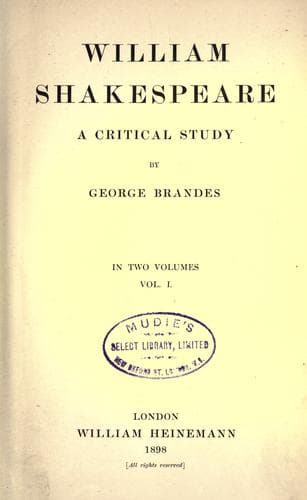
William Shakespeare: A Critical StudyBrandes, Georg
General
William Shakespeare: A Critical Study
Brandes, Georg
Shakespeare, William, 1564-1616 -- Criticism and interpretation
It had been a vernal season, and it was a vernal mood that had uttered
itself in the songs of the many poets. In our days, when the English
language is read by hundreds of millions, the poets of England may be
quickly counted. In those days the country possessed something like
three hundred lyric and dramatic poets, who, with potent productivity,
wrote for a reading public no larger than that of Denmark to-day;
for of the six millions of the population, four millions could not
read. But the talent for writing verses was as widespread among the
Englishmen of that time as the talent for playing the piano among
German ladies of to-day. The power of action and the gift of song did
not exclude each other.
But the blossoming springtide had been short, as springtide always is.
[1] Macaulay, _Essays_--"Burleigh and his Times."
II
_ELIZABETH'S OLD AGE_
At the dawn of the new century the national mood had already altered.
Elizabeth herself was no longer the same. There had always been a dark
side to her nature, but it had passed almost unnoticed in the splendour
which national prosperity, distinguished men, great achievements and
fortunate events had shed around her person. Now things were changed.
She had always been excessively vain; but her coquettish pretences to
youth and beauty reached their height after her sixtieth year. We have
seen how, when she was sixty, Raleigh, from his prison, addressed a
letter to Sir Robert Cecil, intended for her eyes, in which he sought
to regain her favour by comparing her to Venus and Diana. When she was
sixty-seven, Essex's sister, in a supplication for her brother's life,
wrote of that brother's devotion to "her beauties," which did not merit
so hard a punishment, and of her "excellent beauties and perfections,"
which "ought to feel more compassion." In the same year the Queen took
part, masked, in a dance at Lord Herbert's marriage; and she always
looked for expressions of flattering astonishment at the youthfulness
of her appearance.
When she was sixty-eight, Lord Mountjoy wrote to her of her "faire
eyes," and begged permission to "fill his eyes with their onely deere
and desired object." This was the style which every one had to adopt
who should have the least prospect of gaining, preserving, or regaining
her favour.
In 1601 Lord Pembroke, then twenty-one years old, writes to Cecil (or,
in other words, to Elizabeth, in her sixty-eighth year) imploring
permission once more to approach the Queen, "whose incomparable beauty
was the onely sonne of my little world."
Public-domain text, read in full here on John Shaqi.
Reviews
Reviews
No reviews yet
Be the first to share your thoughts on this work.
Elsewhere in the archive
Join the Discussion
Join the discussion
Sign in to leave a comment or review.
Sign InorCreate an account