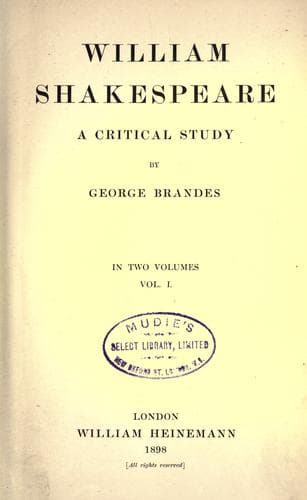
William Shakespeare: A Critical StudyBrandes, Georg
General
William Shakespeare: A Critical Study
Brandes, Georg
Shakespeare, William, 1564-1616 -- Criticism and interpretation
He is from the first described as a bad courtier. Rowland Whyte writes
of him at this time: "He was much blamed for his cold and weeke Maner
of pursuing her Majesties favour, having had soe good steps to lead
him unto it. There is want of Spirit and Courage laid to his charge,
and that he is a melancholy young man." We may gather from this what
fiery devotion every handsome and well-born young man was expected
to pay to the elderly Queen. Soon after, however, it appears from
a letter from his father to Elizabeth that she must have expressed
herself highly satisfied with the young man, and we also learn that he
was "exceedingly beloued at Court of all Men." He appears to have been
very handsome, and to have possessed all the fascination which so often
belongs to an amiable _mauvais sujet_. Clarendon says of him, in the
first book of his _History of the Rebellion_, that "he was immoderately
given up to women," and that "he indulged himself in pleasures of all
kind, almost in all excesses." Clarendon remarks, however, what is of
particular interest for us, that the young Pembroke possessed a good
deal of self-control: "He retained such a power and jurisdiction over
his very appetite, that he was not so much transported with beauty and
outward allurements as with those advantages of the mind as manifested
an extraordinary wit, and spirit, and knowledge, and administered great
pleasure in the conversation. To these he sacrificed himself, his
precious time, and much of his fortune."
In November 1599, Herbert had an hour's private audience with
Elizabeth. Whyte, who relates this, remarks that he now stands high in
the Queen's favour, "but he greatly wants advise." He passed the rest
of the winter in the country, suffering from an illness which seems to
have taken the form of ague, with incessant headaches.
Tyler is inclined, not without reason, to assign Sonnets xc.-xcvi.
to this period. Shakespeare's complaints of his friend's "desertion"
may refer to his life at Court; the expressions in Sonnet xci. as to
horses, hawks, and hounds, perhaps point to the young man's absorption
in sport. The following Sonnets dwell unequivocally upon discreditable
rumours as to the friend's life and conduct. Here appears the
above-quoted (p. 172) line:--
"Lilies that fester smell far worse than weeds."
Here occurs the couplet:--
"How like Eve's apple doth thy beauty grow,
If thy sweet virtue answer not thy show!"
And, in spite of all the loving forbearance which the poet manifests
towards his friend, he seems to imply that the ugly rumours were not
unfounded:--
"How sweet and lovely dost thou make the shame,
Which, like a canker in the fragrant rose,
Doth spot the beauty of thy budding name!
O, in what sweets dost thou thy sins enclose!
That tongue that tells the story of thy days,
(Making lascivious comments on thy sport,)
Cannot dispraise but in a kind of praise;
Naming thy name blesses an ill report.
Public-domain text, read in full here on John Shaqi.
Reviews
Reviews
No reviews yet
Be the first to share your thoughts on this work.
Elsewhere in the archive
Join the Discussion
Join the discussion
Sign in to leave a comment or review.
Sign InorCreate an account