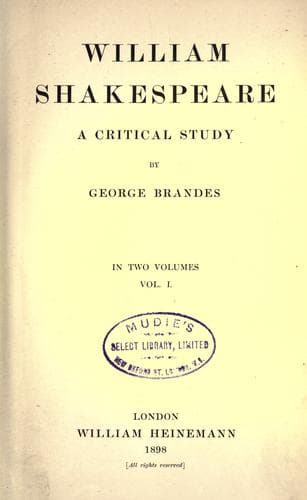
William Shakespeare: A Critical StudyBrandes, Georg
General
William Shakespeare: A Critical Study
Brandes, Georg
Shakespeare, William, 1564-1616 -- Criticism and interpretation
It is not impossible that a passage in Ben Jonson's _Bartholomew Fair_
(1614) may contain a satirical allusion to the relation portrayed in
the Sonnets (published in 1609). In act v. sc. 3 there is presented
a puppet-show setting forth "The ancient modern history of Hero and
Leander, otherwise called the Touchstone of true Love, with as true a
trial of Friendship between Damon and Pythias, two faithful friends o'
the Bankside." Hero is "a wench o' the Bankside," and Leander swims
across the Thames to her. Damon and Pythias meet at her lodging, and
abuse each other most violently when they find that they have but one
love, only to finish up as the best friends in the world.[2]
[1] Reproduced in Tyler's _Shakespeare's Sonnets._
[2]
_"Damon_. Whore-master in thy face;
Thou hast lain with her thyself, I'll prove it in this place.
_"Leatherhead_. They are whore-masters both, sir, that's a plain
case.
_"Pythias_. Thou lie like a rogue.
_"Leatherhead_. Do I lie like a rogue?
_"Pythias_. A pimp and a scab.
_"Leatherhead_. A pimp and a scab!
I say, between you _you have both but one drab_.
_"Pythias and Damon_. Come, now we'll go together to breakfast
to Hero.
_"Leatherhead._ Thus, gentles, you perceive without any denial
'Twixt Damon and Pythias here friendship's true trial."
VII
_PLATONISM--SHAKESPEARE'S AND MICHAEL ANGELO'S SONNETS--THE TECHNIQUE
OF THE SONNETS_
The fact that the person to whom Shakespeare's Sonnets are dedicated
is simply entitled "Mr. W. H." long served to divert attention
from William Herbert, as it was thought that it would have been an
impossible impertinence thus to address, without his title, a nobleman
like the Earl of Pembroke. To us it is clear that this form of address
was adopted precisely in order that Pembroke might not be exhibited
to the great public as the hero of the conflict darkly adumbrated
in the Sonnets. They were not, indeed, written quite without an eye
to publication, as is proved by the poet's promises that they are
to immortalise the memory of his friend's beauty. But it was not
Shakespeare himself who gave them to the press, and bookseller Thorpe
must have known very well that Lord Pembroke would not care to see
himself unequivocally designated as the lover of the Dark Lady and the
poet's favoured rival, especially as that dramatic episode of his youth
ended in a manner which it can scarcely have been pleasant to recall.
Public-domain text, read in full here on John Shaqi.
Reviews
Reviews
No reviews yet
Be the first to share your thoughts on this work.
Elsewhere in the archive
Join the Discussion
Join the discussion
Sign in to leave a comment or review.
Sign InorCreate an account