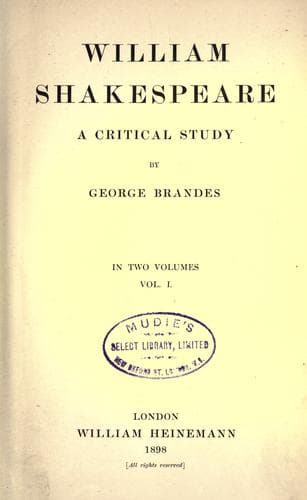
William Shakespeare: A Critical StudyBrandes, Georg
General
William Shakespeare: A Critical Study
Brandes, Georg
Shakespeare, William, 1564-1616 -- Criticism and interpretation
Compare with this picture Shakespeare's conception of an ambitious
Cæsar striving to introduce monarchy into a well-ordered republican
state!
What enchanted every one, even his enemies, who came in contact
with Cæsar, was his good-breeding, his politeness, the charm of his
personality. These characteristics made a doubly strong impression upon
those who, like Cicero, were accustomed to the arrogance and coarseness
of Pompey, so-called the Great. However busy he might be, Cæsar had
always time to think of his friends and to jest with them. His letters
are gay and amiable. In Shakespeare, when he is not familiar, he is
pompous.
For the space of twenty-five years, Cæsar, as a politician, had by
every means in his power opposed the aristocratic party in Rome. He had
early resolved to make himself, without the employment of force, the
master of the then known world, assured as he was that the Republic
would fall to pieces of its own accord. Not until his prætorship in
Spain had he displayed ability as a soldier and administrator outside
the every-day round of political life. Then suddenly, when everything
seems to be prospering with him, he breaks away from it all, leaves
Rome, and passes into Gaul. At the age of forty-four, he enters upon
his military career, and becomes perhaps the greatest commander known
to history, an unrivalled conqueror and organiser, revealing, in middle
life, a whole host of unsuspected and admirable qualities. Shakespeare
conveys no idea of the wealth and many-sidedness of his gifts. He makes
him belaud himself with unceasing solemnity (II. 2):--
"Cæsar shall forth: the things that threaten'd me
Ne'er look'd but on my back; when they shall see
The face of Cæsar, they are vanishèd."
Cæsar had nothing of the stolid pomposity and severity which
Shakespeare attributes to him. He united the rapid decision of the
general with the man of the world's elegance and lofty indifference to
trifles. He liked his soldiers to wear glittering weapons and to adorn
themselves. "What does it matter," he said, "though they use perfumes?
They fight none the worse for that." And soldiers who under other
leaders did not surpass the average became invincible under him.
Public-domain text, read in full here on John Shaqi.
Reviews
Reviews
No reviews yet
Be the first to share your thoughts on this work.
Elsewhere in the archive
Join the Discussion
Join the discussion
Sign in to leave a comment or review.
Sign InorCreate an account