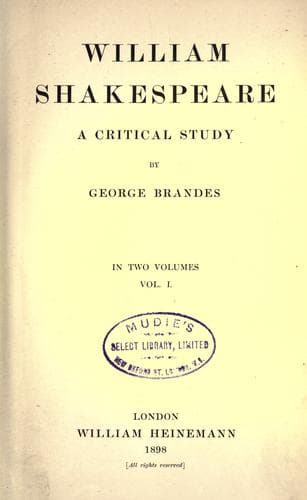
William Shakespeare: A Critical StudyBrandes, Georg
General
William Shakespeare: A Critical Study
Brandes, Georg
Shakespeare, William, 1564-1616 -- Criticism and interpretation
He does not care to impose an oath upon the others; he is too proud.
If they want to betray him, let them! These others, it is true, may
be moved by their hatred of the great man, and eager to quench their
malice in his blood; he, for his part, admires him, and will sacrifice,
not butcher him. The others fear the consequences of suffering Antony
to address the people; but Brutus has explained to the people his
reasons for the murder, so Antony may now eulogise Cæsar as much as
he pleases. Did not Cæsar deserve eulogy? Does not he himself desire
that Cæsar shall lie honoured, though punished, in his grave? He is too
proud to keep a watch upon Antony, who has approached him in friendly
fashion, though at the same time in the character of Cæsar's friend;
therefore he leaves the Forum before Antony begins his speech. Such
moods are familiar to many. Many another has acted in this apparently
unwise way, proudly reckless of consequences, moved by the dislike
of the magnanimous man for all that savours of base cautiousness.
Many a one, for example, has told the truth where it was stupid to
do so, or has let slip an opportunity of revenge because he despised
his enemy too much to seek compensation for his injuries, though he
thereby neglected to render him innocuous for the future. An intense
realisation of the necessity for confidence, or, on the other hand, of
the untrustworthiness of friends and the contemptibleness of enemies,
may easily lead one to despise every measure of prudence.
It was upon the basis of an intense feeling of this nature that
Shakespeare created Brutus. With the addition of humour and a touch of
genius he would be Hamlet, and he becomes Hamlet. With the addition of
despairing bitterness and misanthropy he would be Timon, and he becomes
Timon. Here he is the man of uncompromising character and principle,
who is too proud to be prudent and too bad an observer to be practical;
and this man is so situated that not only the life and death of another
and of himself, but the welfare of the State, and even, as it appears,
that of the whole civilised world, depend upon the resolution at which
he arrives.
At Brutus's side Shakespeare places the figure which forms his female
counterpart, the kindred spirit who has become one with him, his cousin
and wife, Cato's daughter married to Cato's disciple. He has here, and
here alone, given us a picture of the ideal marriage as he conceived it.
Public-domain text, read in full here on John Shaqi.
Reviews
Reviews
No reviews yet
Be the first to share your thoughts on this work.
Elsewhere in the archive
Join the Discussion
Join the discussion
Sign in to leave a comment or review.
Sign InorCreate an account