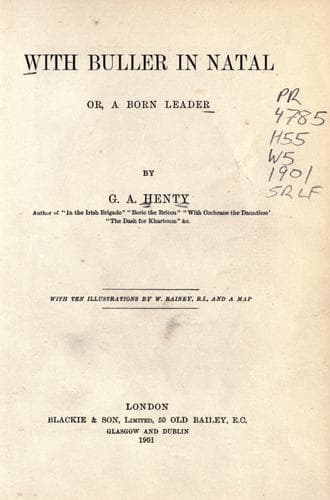
With Buller in Natal, Or, a Born LeaderHenty, G. A. (George Alfred)
General
With Buller in Natal, Or, a Born Leader
Henty, G. A. (George Alfred)
South African War, 1899-1902 -- Fiction
"The only wonder to me is," another officer said, "that the Boers did
not take up and drag away the rails all the way from here to Estcourt.
If they had lifted them out of their sleepers, they had only to harness
a rail behind each horse and trot off with it. I know that there is a
considerable amount of railway material at Durban, but I doubt if there
is anything like sufficient to make twenty miles of road. And the
business would have been still more difficult if the Boers had
collected the sleepers in great piles and burned them. Of course they
have destroyed a good many culverts and the bridge at Estcourt. It is
wonderful that the railway people should have managed to get up a
temporary trestle bridge so soon, and to make a deviation of the line
to carry the trains over. It does their engineers immense credit. This
pass is widening," he added after putting his head out of the window.
"I fancy we shall be at Chieveley in a few minutes."
The train came to a stand-still at a siding a short distance outside
the station, which was crowded by a long line of waggons with stores of
all kinds. A number of sailors were unloading shells for their guns,
and a crowd of Kaffirs, under the orders of military officers, were
getting out the stores. As they alighted, after hearty thanks to the
officer whose kindness had been the means of their getting forward so
promptly, and who now went to report his arrival to Captain Jones, who
was superintending the operations of the sailors, Chris and his party
hurried to the rear waggon. It was a work of considerable difficulty to
get the horses out, and could not have been accomplished had there not
been a stack of sleepers near the spot. A number of these were carried
and piled so as to make a sloping gangway, by which the horses were
brought down. The sleepers being returned to their places, Chris and
his friends mounted and rode to the camp, which was placed behind a
long, low ridge which screened it from the sight of the enemy on the
opposite hills, although within easy range of their heavy guns.
Here before daybreak on the 12th, Major-general Barton's Fusilier
brigade, with a thousand Colonial Cavalry, three field batteries, and
the naval guns, had marched north, and were the following night joined
by another brigade with some cavalry. The next day the big naval guns
had opened fire; but although their shell had reached the lower
entrenchments of the Boers, their batteries on the hill had proved to
be beyond their range even with the greatest elevation that could be
given to them, while the Boer guns carried far beyond the camp.
Chris had learned at Estcourt, where the train stopped a few minutes,
that Captain Brookfield's troop formed part of the Colonial Horse that
had advanced with General Barton's brigade, and they soon discovered
their position. Leaving the horses with the natives, they went to his
tent.
Public-domain text, read in full here on John Shaqi.
Reviews
Reviews
No reviews yet
Be the first to share your thoughts on this work.
Elsewhere in the archive
Join the Discussion
Join the discussion
Sign in to leave a comment or review.
Sign InorCreate an account