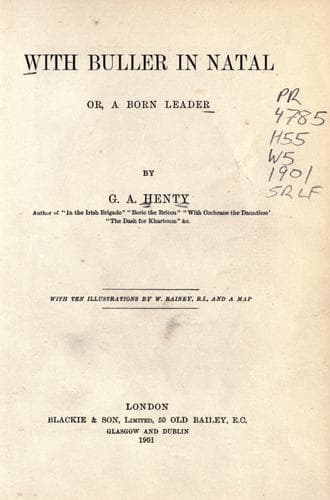
With Buller in Natal, Or, a Born LeaderHenty, G. A. (George Alfred)
General
With Buller in Natal, Or, a Born Leader
Henty, G. A. (George Alfred)
South African War, 1899-1902 -- Fiction
"I never thought that you were a croaker before," Field said, "except
just before the last fight; but certainly things have gone very badly
lately. Three disasters in seven or eight days are a facer; but I
cannot think that we shall not succeed next time. When Warren's
division is up Buller will have over thirty thousand men with him, in
spite of our losses the other day, and we ought to be able to do it
with that."
"Well, we shall see, Field. I hope you are right."
The news of Methuen's repulse and the terrible losses in the Highland
brigade, and of Gatacre's disaster, cast a greater gloom over Buller's
army than their own failure had done. The one topic of conversation
among the officers was, what would be the feeling in England, and
whether there would be any inclination to patch up another
dishonourable peace like that after Majuba. But the feeling wore off as
day after day the news came that the misfortunes had but raised the
spirit and determination of the people of Great Britain to carry the
war through to the bitter end; that recruiting was going on with
extraordinary rapidity; that fresh regiments had been ordered out; that
Lord Roberts had been appointed to the supreme command in South Africa,
and that Lord Kitchener was coming out as chief of his staff. The fact,
too, that the volunteers had been asked to send companies to the
regiments to which they were attached, that the City had undertaken to
raise a strong battalion at its own expense, that the Yeomanry were to
furnish ten thousand men, and that public, spirit had risen to fever
heat, soon showed that these apprehensions were without foundation, and
that Britain was still true to herself, and was showing the same
indomitable spirit that had carried her through many periods of
national depression, and brought her out triumphant at the end.
Christmas passed cheerily; no gun was fired on either side, although
the Boers worked diligently at their trenches; and our men feasted as
they had not done since they landed at Durban. Bacon, milk, fresh
bread, beef, and a quart of beer were served out for each man, and on
these men and officers made a memorable meal; the latter producing the
last bottles of wine and spirits that had been specially sent up to
them from Maritzburg. And on that and the following day there were
sports--lemon-cutting, tent pegging, races for the cavalry; athletic
sports, tugs-of-war, mule and donkey races for the infantry. The drums
and fifes played national airs, and the sailors bore their full share
in the fun. As time went on the preparations for the next move
advanced. None were more pleased at the prospect of active work again
than the Colonial Volunteers, who had several times entreated to be
allowed to get out and drive back the bands of plundering Boers, who
were still wasting the farms and destroying the farmhouses and
furniture of the loyalists.
Public-domain text, read in full here on John Shaqi.
Reviews
Reviews
No reviews yet
Be the first to share your thoughts on this work.
Elsewhere in the archive
Join the Discussion
Join the discussion
Sign in to leave a comment or review.
Sign InorCreate an account