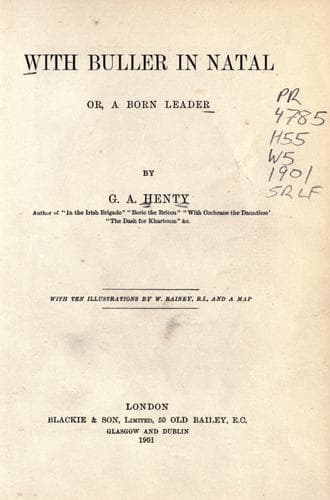
With Buller in Natal, Or, a Born LeaderHenty, G. A. (George Alfred)
General
With Buller in Natal, Or, a Born Leader
Henty, G. A. (George Alfred)
South African War, 1899-1902 -- Fiction
After riding at full speed for eight or nine miles, they broke into a
walk, stopping every few minutes to listen. They knew that they would
be able to hear the sound of pursuit at least a mile away, and as their
ponies would start fresh again, they were able to take things quietly.
So sometimes cantering sometimes walking, they reached the river at
about one o'clock in the morning. On the opposite bank stood the little
village of Tugela Ferry. Here there was a drift, and there was no
occasion to use the ferry-boat except when the river was swollen by
rain. It now reached only just up to the ponies' bellies; they
therefore crossed without the least difficulty, and after passing
through the village, left the road, and struck off across the country
to the south-west. When four or five miles away they halted at a donga,
and leading the ponies down, turned them loose to feed, ate their
supper, and were soon asleep.
It was no longer necessary to travel by night, and at eight o'clock
they started again. They kept a sharp look-out from every eminence, and
once or twice saw parties of mounted men in the distance and made
detours to avoid them. So far as they were aware, however, they were
not observed. The distance to be ridden from their last halting-place
was about thirty-five miles, and at one o'clock they were within five
miles of Estcourt. On an eminence about a mile in front of them they
saw a solitary horseman.
"That is evidently one of our scouts," Chris said. "I dare say there is
a party of them somewhere behind him. If I am not mistaken I can see
two or three heads against the sky-line--they are either heads or
stones. We should know more about it if the Boers hadn't bagged our
glasses when they took us."
Two or three minutes later Sankey said, "Those little black spots have
gone, so they were heads. I dare say they are wondering who we are, and
put us down either as Boers or as loyal farmers, though there cannot be
many of them left in this district."
Presently from behind the foot of the hill six horsemen dashed out. The
lads had already taken the precaution of taking off their hats and
putting on forage-caps again.
"It is always better to avoid accidents," Chris said. "It would have
been awkward if they had begun to shoot before waiting to ask
questions, especially as we could not shoot back. They are Colonials;
one can see that by their looped-up hats, which are a good deal more
becoming than those hideous khaki helmets of our men."
The horsemen had unslung their guns, but seeing that the strangers had
their rifles still slung behind them with apparently no intention of
firing, they dropped into a canter until they met the lads.
"Who are you?" the leader asked. "Do you surrender?"
"We will surrender if you want us to," Chris said; "though why we
should do so I don't know. We belong to the Maritzburg Scouts, and were
taken prisoners, being both wounded, eight or nine days ago; and, as
you see, we have got away."
Public-domain text, read in full here on John Shaqi.
Reviews
Reviews
No reviews yet
Be the first to share your thoughts on this work.
Elsewhere in the archive
Join the Discussion
Join the discussion
Sign in to leave a comment or review.
Sign InorCreate an account