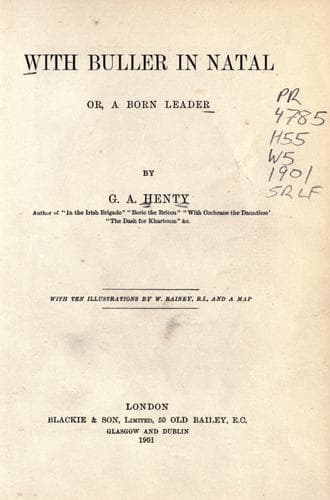
With Buller in Natal, Or, a Born LeaderHenty, G. A. (George Alfred)
General
With Buller in Natal, Or, a Born Leader
Henty, G. A. (George Alfred)
South African War, 1899-1902 -- Fiction
"No; that was the night we were at Glencoe. On our way up we did hear
some very heavy firing. At least, we were not certain that it was
firing, and rather thought it was a distant thunder-storm."
"The firing began at two o'clock in the morning," Captain Brookfield
said, "and was so heavy that everyone turned out. It lasted four hours,
and there was no doubt that the Boers were making a determined attack.
Everyone wondered that we did not at once make a diversion. When the
day broke it could be seen that numbers of mounted Boers were hurrying
off from their camps among the hills towards Ladysmith, but it was not
until two in the afternoon that five battalions of infantry marched
down towards Colenso, and the naval guns opened in earnest on their
lines. It had the effect of bringing the Boers scurrying down again to
their trenches. Our fellows marched in open order and worked their way
nearly down to Colenso, which was more strongly garrisoned than it had
been at the time of our last attack. No doubt they had seen us
preparing to advance, and strongly reinforced the garrison. Our guns
were taken a long way down, and at six o'clock their trenches were
bombarded; then it came on to rain, and the Boers ceased to fire, and
at seven o'clock our men turned into camp. The firing in Ladysmith had
ceased some time before that."
"And what had taken place there?" Chris asked anxiously, "for I know
the place has not fallen or we should have heard of it."
"No, they beat the Boers off splendidly. However, they had hard work to
do it, for the heliograph flashed a signal at about nine o'clock in the
morning to say that they had so far beaten off the enemy, but were much
pressed. We heard the next day that this had indeed been the case.
Caesar's Camp had been taken and retaken several times--by our men at
the point of the bayonet, by the Boers, by rushing up in overwhelming
numbers. It is said that we have twelve hundred casualties, and the
Boers at least fifteen hundred, of whom a large number were bayoneted.
They say the loss fell chiefly upon the Free Staters, who were put in
the front by the Transvaal people. They fought pluckily, and several of
their commanders were among the killed. I should think that they would
hardly try it again. A native got through two days afterwards with a
despatch. We have not heard what it contained, but we fancy from what
has leaked out that our defences were very weak."
"We ought to take a lesson from the Boers," Chris said. "I saw
something of their trenches as we went up the railway valley, and they
are wonderful."
Public-domain text, read in full here on John Shaqi.
Reviews
Reviews
No reviews yet
Be the first to share your thoughts on this work.
Elsewhere in the archive
Join the Discussion
Join the discussion
Sign in to leave a comment or review.
Sign InorCreate an account