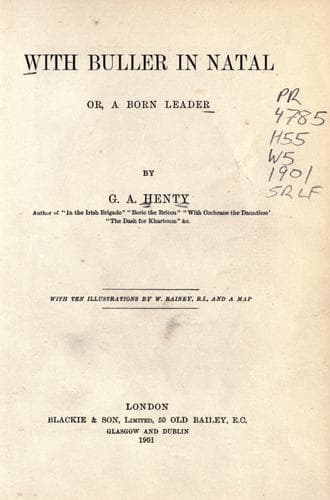
With Buller in Natal, Or, a Born LeaderHenty, G. A. (George Alfred)
General
With Buller in Natal, Or, a Born Leader
Henty, G. A. (George Alfred)
South African War, 1899-1902 -- Fiction
He went on. "I am an old army man, and have been as staunch a believer
in army traditions as any man, but I tell you fairly that I am
disgusted at the amount of routine work, delay, and, if I may use the
word, priggism, that I see going on. I am not surprised that the
Colonials to a man are convinced that they would manage matters
infinitely better if they were left to themselves. They would harass
the Boers night and day, sweep their plundering parties out of the
land, make a circuit no matter how far into Zululand, and come down
behind and cut the line of railway, and blow up the bridges, and worry
them out of the colony. I don't say they would succeed, but I am sure
they would try, and I believe firmly that five thousand mounted
Colonials fighting in their own way would relieve Ladysmith and clear
Natal sooner than we with thirty thousand shall do. I am not saying
that they would succeed in a Continental war, though they would
certainly harass and bother any regular force four times their own
strength. To succeed they would require guns and a greater degree of
discipline than they have got, but such a force would be absolutely
invaluable as an assistant to a regular army. Don't repeat what I say,
Chris; there is a good deal of soreness of feeling on both sides
already, and I don't want any utterance of mine to add to it. Still, I
can assure you it has been a relief to me to let the steam off."
At the appointed hour the Maritzburg Scouts and another Colonial corps
started with a train of two hundred waggons, and with immense exertion
made eight miles before it became dark. The men were more often on foot
than in their saddles, sometimes roping their horses to the sides of
the waggons to aid the oxen, sometimes putting their shoulders to the
wheels, or working with a score of others with railway sleepers that
had been brought for the purpose, to lever the axles out of deep holes
into which the wheels had sunk.
"I don't think I ever knew what it was to be really dirty before,"
Field said, as they finally dismounted and prepared to camp. "I thought
I did know something about mud, but I can see that I did not. I feel
that I am a sort of animated pie, and could be cooked comfortably in an
oven. If we could but get a big fire and stand round it, our crust
might peel off; and I really don't see any other way. There is one
advantage in it, and that is that we shall be able to skirmish, if
necessary, across either a sandy or muddy country, without the
possibility of our being made out more than fifty yards away by the
keenest-sighted Boer. What do you propose, Captain Chris? If there were
running water near, the course would be clear. We would lie down by
turns, and be rolled over and over, and thumped with stones, and rubbed
with anything that came handy till we were in a state of comparative
cleanliness."
"Why running water?" Chris asked. "Why not a pond?"
Public-domain text, read in full here on John Shaqi.
Reviews
Reviews
No reviews yet
Be the first to share your thoughts on this work.
Elsewhere in the archive
Join the Discussion
Join the discussion
Sign in to leave a comment or review.
Sign InorCreate an account