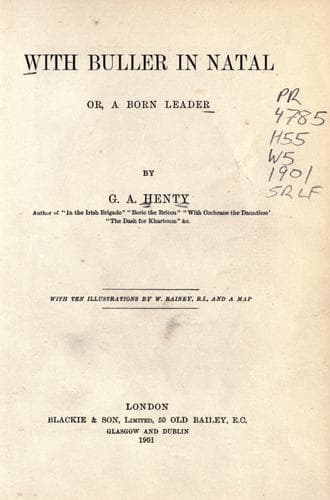
With Buller in Natal, Or, a Born LeaderHenty, G. A. (George Alfred)
General
With Buller in Natal, Or, a Born Leader
Henty, G. A. (George Alfred)
South African War, 1899-1902 -- Fiction
The country immediately round Springfield was level and well
cultivated, with pretty farmhouses and orchards scattered about. Some
little distance to the west rose two hills, Swartz Kop, which had been
occupied by the mounted infantry, and Spearman's Hill, named from a
farm near its base. Here General Buller had established his
head-quarters. Spearman's Hill, which was generally called Mount Alice,
was a very important position, and here the naval guns were placed,
their fire commanding the greater portion of the hills on the other
side of the Tugela, and also Potgieter's Drift, where it was intended
the passage of the river should be made. Swartz Kop was a less
important position, though it also dominated a wide extent of country;
but as ridges on the other side covered some important points from its
fire, Mount Alice was selected as the position for the naval battery,
and also for the signallers, as from here a direct communication could
be kept up by heliograph and flash-light with one of the hills held by
the defenders of Ladysmith.
[Illustration: THE NAVAL GUNS ON MOUNT ALICE]
It was late on the 16th when the convoy which the Maritzburg Scouts
were escorting arrived at Springfield. All day they had heard the boom
of artillery and the rattle of machine-guns and musketry along the line
of hills on the other side of the Tugela and from the heights of Mount
Alice, and groaned in spirit as they laboured at their work of
assisting the waggons, that they were thus employed when hard fighting
was going on within eight miles of them.
At half-past two that day Lyttleton's brigade had moved forward along
the foot of Mount Alice to force the passage of the river at
Potgieter's drift. As soon as the Boers caught sight of them, they
could be seen galloping forward to take their places in the trenches.
A thunder-storm that burst and a torrent of rain screened the movements
of the advancing troops from view for some time, and enabled them to
near the river without having to pass through any shell fire from the
Boer batteries on the hilltops. Between Mount Alice and the river the
brigade passed across meadows and ploughed fields. They reached the
ferry, but the boat was stuck fast, and an hour was lost at this point
before a party of sailors and colonial troops accustomed to such work
came forward to the aid of the Engineers, and speedily got it into
working order. But in the meantime the Scottish Rifles and the Rifle
Brigade had moved along the banks to the drift. Although usually almost
dry, the water was now coming down it breast-deep. Two gallant fellows
went across, and when they found the line of shallow water they
returned and guided their comrades over. The rush of the water was so
great that many would have been swept away; but, joining hands, they
crossed in a line, and although this was broken several times, it was
always reformed, and not many lives were lost.
Public-domain text, read in full here on John Shaqi.
Reviews
Reviews
No reviews yet
Be the first to share your thoughts on this work.
Elsewhere in the archive
Join the Discussion
Join the discussion
Sign in to leave a comment or review.
Sign InorCreate an account