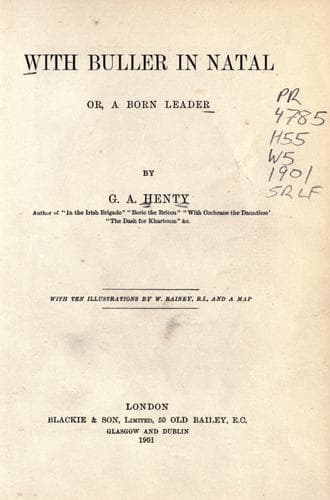
With Buller in Natal, Or, a Born LeaderHenty, G. A. (George Alfred)
General
With Buller in Natal, Or, a Born Leader
Henty, G. A. (George Alfred)
South African War, 1899-1902 -- Fiction
Thus, then, they were in no condition to reckon the comparatively small
numbers of their assailants, and as they saw the Irishmen dashing
forward, cheering loudly, with pointed bayonets, they hesitated, and
then bolted up the hill to the next trench. Instead of waiting until
the supports had come up for another rush, the Irishmen with a cheer
dashed across the trench in hot pursuit. But the next line was far more
strongly manned, and a storm of bullets swept among them. Still, for a
time they kept on, but wasting so rapidly that even the most desperate
saw that it could not be done; and, turning, the survivors retreated to
the trench that they had already won, while the supports fell back to
the railway, both suffering heavily in the retreat. No fewer than two
hundred of the Inniskillings had fallen in that desperate charge, their
colonel and ten officers being either killed or wounded, while the
Dublins also lost their colonel.
All through the night the trench was held sternly, in spite of repeated
and desperate efforts of the Boers to dislodge its defenders. Nothing
could be done for those who lay wounded on the hill above. Morning
broke, and the fight still continued. At nine o'clock another desperate
charge was made; but the Boers were unable to face the steady fire that
was maintained by the defenders of the trench, and they again turned
and ran for their shelters. Just as this attack was repulsed,
Lyttleton's brigade arrived on the scene, exchanging a hearty cheer
with the men who had so long borne the brunt of this terrible conflict.
The Durham Light Infantry at once relieved those in the trenches, and
these descended the hill for the rest that was so much needed. All that
day the fighting continued, and while Lyttleton's men held to the
position on Railway Hill, there was fierce fighting away to the left,
where the Welsh Fusiliers and other regiments were hotly engaged. The
roar of artillery and musketry never ceased all day, but towards
evening white flags were hoisted on both sides, and a truce was agreed
upon for twelve hours to bury the dead.
Public-domain text, read in full here on John Shaqi.
Reviews
Reviews
No reviews yet
Be the first to share your thoughts on this work.
Elsewhere in the archive
Join the Discussion
Join the discussion
Sign in to leave a comment or review.
Sign InorCreate an account