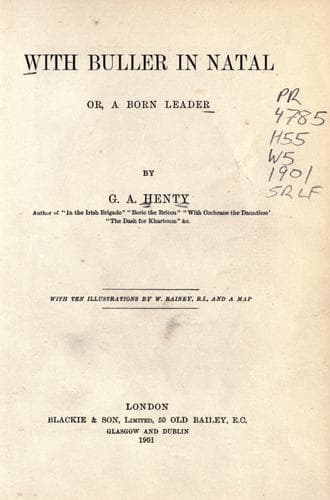
With Buller in Natal, Or, a Born LeaderHenty, G. A. (George Alfred)
General
With Buller in Natal, Or, a Born Leader
Henty, G. A. (George Alfred)
South African War, 1899-1902 -- Fiction
situation to the more exposed camps on the summit of the hills. The
amount of provisions and stores of all kinds was large, Great
quantities of rifle ammunition were found in every trench. Clothes of a
superior kind proved that their owners had been residents of
Johannesburg or Pretoria, and of a different class altogether from the
farm-labourers and herdsmen who formed the majority of the Boer army.
The haste with which they had fled, when to their astonishment they
discovered that the British attack could not be repulsed, was shown by
the fact that a good many watches were found on bed-places and rough
tables where they had been left when the Boers rushed to arms, and in
the hurry of flight had been forgotten.
The number of rifles that had been thrown away was very large. Among
the dead bodies found were those of two women, one quite young and the
other over sixty. It was notorious that women had more than once been
seen in the firing ranks of the Boers, and there were reports that
Amazon corps were in course of formation in the Transvaal, the Boers,
perhaps, remembering how sturdily the women of Haarlem had fought
against the Spaniards in defence of their city.
So complete had been the panic evinced by the headlong fight of the
enemy that the general opinion was that it would be some time before
they would again attempt a stand against our men, and that unless any
entrenchments higher up the valley were held by men who had not
witnessed what had taken place, and were commanded by leaders of the
most determined character, Ladysmith would almost certainly be relieved
within a couple of days, and the rescuing army would be thus rewarded
for its toils and sacrifices.
In a state of the wildest delight the lads returned to the spot where
they had left their horses, where they found that Japhet and the two
Swazis had arrived just before them. They and the Zulus were exhibiting
their intense satisfaction at the defeat of the Boers by a wild
war-dance. The party rode fast back to camp, for their spirits did not
admit of a leisurely pace, and they left the natives to follow them
more deliberately. The news had already been received in camp by the
return of officers who witnessed the scene from a point near to that
which the lads had attained, and its occupants were in a frenzy of
delight. The Colonial corps were especially jubilant. This was the
anniversary of Majuba Hill, the blackest in the history of the Colony,
and one that the Boers in the Transvaal and Orange State always
celebrated with great rejoicings, to the humiliation of the British
Colonists. Now that disgrace was wiped out. A position even stronger
than that of Majuba, fortified with enormous pains, defended by
artillery and by thousands of Boers, had been captured by a British
force, and although it was as yet unknown in camp, the old reverse had
been doubly avenged by the surrender on that day of Cronje and his army.
Public-domain text, read in full here on John Shaqi.
Reviews
Reviews
No reviews yet
Be the first to share your thoughts on this work.
Elsewhere in the archive
Join the Discussion
Join the discussion
Sign in to leave a comment or review.
Sign InorCreate an account