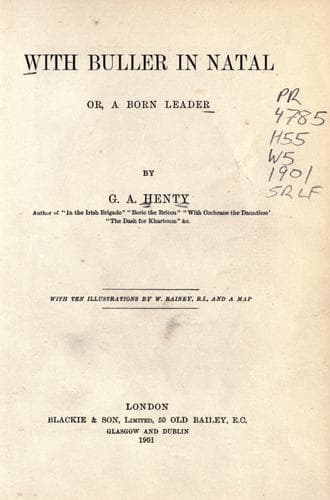
With Buller in Natal, Or, a Born LeaderHenty, G. A. (George Alfred)
General
With Buller in Natal, Or, a Born Leader
Henty, G. A. (George Alfred)
South African War, 1899-1902 -- Fiction
to abate, and the set expression of the faces to relax. Then as the
hills receded and the valley opened before them a pleasurable
excitement succeeded the grim expectation of battle. The task that had
proved so hard was indeed fulfilled; the Boers were gone, and the siege
of Ladysmith was at an end. As they emerged from the valley into the
plain in which Ladysmith is situated, there was an insensible increase
of speed; men talked joyously together, scarcely waiting for replies;
the horses seemed to catch the infection of their riders' spirits, and
the pennons of the Lancers in front to flutter more gaily. Onward they
swept, cantering now until they approached the town.
Then men could be seen running towards the road; from every house they
poured out, men and women, some waving hats and handkerchiefs, some too
much overpowered by their feelings for outward demonstrations. As the
columns reached this point they broke into a walk, and answered with
ringing cheers the fainter but no less hearty hurrahs of those they
came to rescue; and yet the troopers themselves were scarcely less
affected than the crowd that pressed round to shake them by the hand.
They had known that provisions were nearly exhausted in the city, and
that for some time past all had been on short rations; but they had not
dreamt of anything like this. It seemed to them that they were
surrounded by a population of skeletons, haggard and worn, almost too
weak to drag themselves along, almost too feeble to shout, their
clothes in rags, their eyes unnaturally large, their hands nerveless,
their utterances broken by sobs. They realized for the first time how
terrible had been the privations, how great the sufferings of the
garrison and people of Ladysmith. For the soldiers were there as well
as the civilians. There was little military in their appearance; there
was no uniformity in their dress, save that all were alike ragged,
stained and destitute of colour.
Could their rescuers have seen them, themselves unseen, a few days
earlier, they would have been even more shocked. Then the listlessness
brought about by hope deferred, and of late almost the extinction of
hope, weakness caused by disease and famine, had been supreme; and had
the Boers had any idea of the state to which they were reduced, a
renewal of the attack of the eth of January could hardly have failed of
success. The last few days, however, had revived their hopes. They had
learned by the ever-nearing roar of the cannon that progress was being
made, and for the past four days had from elevated points near the town
been able to make out the movements of our troops on the positions they
had captured. They had seen the Boers breaking up their camps, carrying
off their stores either by waggon across the western passes or by the
trains from Modder Spruit. They had seen the cannon being withdrawn
from their positions on the hills, and felt that their deliverance was
at hand.
Public-domain text, read in full here on John Shaqi.
Reviews
Reviews
No reviews yet
Be the first to share your thoughts on this work.
Elsewhere in the archive
Join the Discussion
Join the discussion
Sign in to leave a comment or review.
Sign InorCreate an account