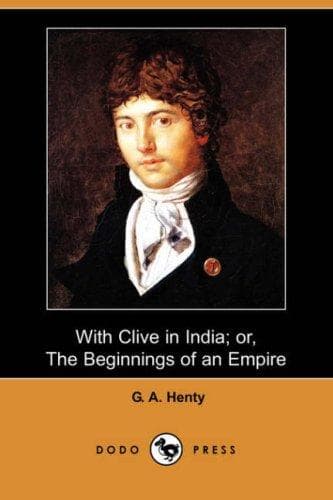
With Clive in India; Or, The Beginnings of an EmpireHenty, G. A. (George Alfred)
History
With Clive in India; Or, The Beginnings of an Empire
Henty, G. A. (George Alfred)
India -- History -- British occupation, 1765-1947 -- Fiction
From the point where Clive had crossed the Bhagirathi it was fifteen
miles to Plassey, following, as they did, the curves of the river. It
was necessary to do this, as they had no carriage; and the men were
obliged to tow their supplies in boats, against the stream.
Orders were issued that, as soon as the troops were across, they
should prepare to eat their dinners, as the march was to be resumed at
once. The rain was coming down in a steady pour as the troops,
drenched to the skin, started upon their march. The stream, swollen by
the rains, was in full flood, and the work of towing the heavy-laden
barges was wearisome in the extreme. All took a share in the toil. In
many cases the river had overflowed its banks, and the troops had to
struggle through the water, up to their waists, while they tugged and
strained at the ropes.
Charlie, as a mounted officer, rode at the head of his Sepoys; who
formed the advance of the force. Three hundred men preceded the main
body, who were towing the boats, to guard them from any sudden
surprise. Tim marched beside him, occasionally falling back, and
taking a turn at the ropes.
"This is dog's work, Mister Charles," he said. "It's lucky that it's
raining, for the river can't make us wetter than we are. My hands are
fairly sore, with pulling at the ropes."
"Ah, Tim, you're not fond of ropes, you know. You remember that night
at Moorshedabad."
"Faith, yer honor, and I'll not forget it, if I live to be as old as
Methuselah. Well, yer honor, it will be hard on us if we do not thrash
them niggers, tomorrow, after all the trouble we are taking to be at
them."
At one o'clock in the morning, the weary troops reached the village of
Plassey. They marched through it, and halted and bivouacked in a large
mango grove, a short distance beyond.
Chapter 23: Plassey.
Scarcely had the soldiers taken off their packs, when the sound of
martial music was heard. Charlie was speaking, at the time, to Major
Coote.
"There are the enemy, sure enough," the latter said. "That old rascal,
Meer Jaffier, must have been deceiving us when he said that the nabob
had halted at Mankarah. I'm afraid he means to play us false."
"I expect," Charlie remarked, "that he does not know what he means,
himself. These Asiatics are at any time ready to turn traitors, and to
join the strongest. At present, Jaffier does not know what is the
stronger; and I think it likely enough that he will take as little
share as he can in the battle, tomorrow, till he sees which way it is
going. Then, if we are getting the best of it, the rascal will join
us, for the sake of the advantages which he expects to gain. If the
day is going against us, he will do his best to complete his master's
victory; and should proofs of his intended treachery ever come to
light, he will clear himself by saying that he intended to deceive us
all along, and merely pretended to treat with us, in order to throw us
off our guard, and so deliver us into the hands of his master."
Public-domain text, read in full here on John Shaqi.
Reviews
Reviews
No reviews yet
Be the first to share your thoughts on this work.
Elsewhere in the archive
Join the Discussion
Join the discussion
Sign in to leave a comment or review.
Sign InorCreate an account