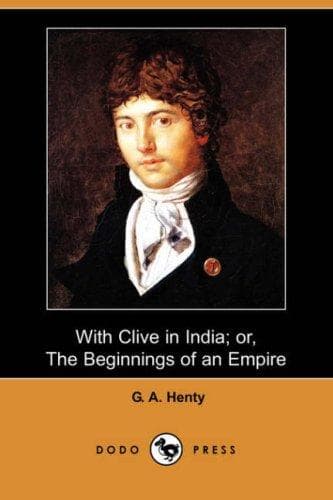
With Clive in India; Or, The Beginnings of an EmpireHenty, G. A. (George Alfred)
History
With Clive in India; Or, The Beginnings of an Empire
Henty, G. A. (George Alfred)
India -- History -- British occupation, 1765-1947 -- Fiction
As the health of the two officers was shaken by their long and arduous
work, and their services were not, for the moment, needed, they
obtained leave for three months, and went down in a coasting ship to
Columbo, where several English trading stations had been established.
Here they spent two months, residing for the most part among the
hills, at the town of a rajah very friendly to the English; and with
him they saw an elephant hunt, the herd being driven into a great
inclosure, formed by a large number of natives who had, for weeks,
been employed upon it. Here the animals were fastened to trees by
natives, who cut through the thick grass unobserved; and were one by
one reduced to submission, first by hunger, and then by being lustily
belaboured by the trunks of tamed elephants. Tim highly appreciated
the hunt, and declared that tiger shooting was not to be compared to
it.
Their residence in the brisk air of the hills completely restored
their health, and they returned to Madras perfectly ready to take part
in the great operations which were impending. Charlie, on his return,
was appointed to serve as chief of the staff to Colonel Coote; Captain
Peters being given the command of a small body of European horse, who
were, with a large body of irregulars, to aid in bringing in supplies
to the British army, and to prevent the enemy from receiving food from
the surrounding country.
Early in June, the British squadron off the coast was joined by two
ships of the line, the Norfolk and Panther, from England; and a
hundred Europeans, and a detachment of European and native artillery
came down from Bombay.
Around Pondicherry ran a strong cactus hedge, strengthened with
palisades, and the French retired into this at the beginning of July.
They were too strongly posted there to be attacked by the force with
which the English at first approached them, and they were expecting
the arrival of a large body of troops from Mysore, with a great convoy
of provisions.
On the 17th these approached. Major Moore, who was guarding the
English rear, had a hundred and eighty European infantry; fifty
English horse, under Peters; sixteen hundred irregular horse; and
eleven hundred Sepoys. The Mysoreans had four thousand good horse, a
thousand Sepoys, and two hundred Europeans, with eight pieces of
cannon.
The fight lasted but a few minutes. The British native horse and
Sepoys at once gave way; and the English infantry retreated, in great
disorder, to the fort of Trivadi, which they gained with a loss of
fifteen killed and forty wounded. Peters' horse alone behaved well.
Several times they charged right through the masses of Mysorean horse;
but when five-and-twenty were killed, and most of the rest, including
their commander, severely wounded, they also fell back into the fort.
Public-domain text, read in full here on John Shaqi.
Reviews
Reviews
No reviews yet
Be the first to share your thoughts on this work.
Elsewhere in the archive
Join the Discussion
Join the discussion
Sign in to leave a comment or review.
Sign InorCreate an account