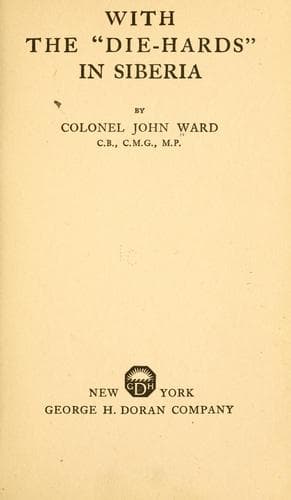
World War, 1914-1918 -- Personal narratives, English; World War, 1914-1918 -- Russia (Federation) -- Siberia
The conspirators broke up at once, but the cunningest of the lot
remained to weave again by social strategy the continuous web of Russian
disorder. We knew that there were elements at work for a
counter-revolution quite uncontrolled by, but acting with, the
cognisance of officials of the Koltchak Administration. In revolutions
sudden outbursts on the part of even a small party may soon jeopardise
the whole organisation of State. Colonel Johnson and myself agreed that
it was necessary to concentrate our forces, and in approaching the
Russian authorities on this subject, we added further to the
demoralisation of those who were in the conspiracy. We protested that it
was our own safety that we had in view, but the conspirators did not
believe us. I knew that the admiral's train had been for some days
standing ready to take him to the front. On February 3 Omsk was informed
that the important Japanese Mission (previously referred to) had started
from Irkutsk on the last stage of its journey to the Supreme Governor.
The governor's aide-de-camp informed me at the same time that the
admiral was starting for the front at 5 P.M. on February 7.
General Knox was anxious that there should be no evidence of weakening
in our support of the Omsk Government, as in case of disorder our
position was by no means secure. After consultation it was decided to
offer the admiral a personal guard for his journey, to consist of fifty
men and one officer from the Hampshire Regiment. This was accepted and
referred to the Chief of Staff for confirmation. It was then reported to
General Ganin and the French Staff. They at once protested that to have
a purely English guard would lower French prestige in the eyes of the
Russians. They quite agreed that there ought to be a guard, but it must
be half English and half French, and to this we at once agreed. We
therefore reduced our number to twenty-five. Then, however, the French
Staff pointed out that they had no troops in Omsk, and they could not
leave the Staff without a cook. The greatest number of orderlies they
could spare was nine, so it was suggested that the guard should consist
of forty-one English and nine French soldiers. This took the
negotiators' breath away entirely; the first proposal was destructive of
French prestige, the second was enough to destroy France altogether!
Really France is much too beautiful and gallant a country to have this
sort of stuff put forward on her behalf, but there it was. So the
admiral's guard consisted of nine soldiers with one officer of each
nationality--twenty all told.
Public-domain text, read in full here on John Shaqi.
Reviews
Reviews
No reviews yet
Be the first to share your thoughts on this work.
Elsewhere in the archive
Join the Discussion
Join the discussion
Sign in to leave a comment or review.
Sign InorCreate an account