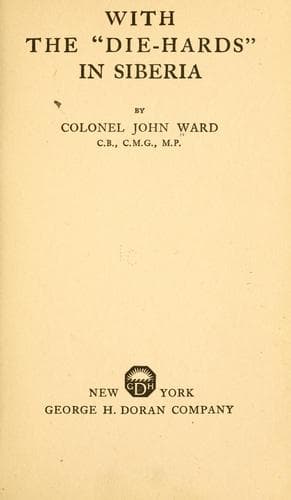
World War, 1914-1918 -- Personal narratives, English; World War, 1914-1918 -- Russia (Federation) -- Siberia
The sentiments of the people changed completely every few hundred
miles. After leaving Irkutsk we soon discovered that we were in enemy
territory, and the few weeks, and in some cases days, that had elapsed
since the retirement of the Bolshevik Commissars had left the country
the prey of the desperado. Let there be no mistake, Bolshevism lived by
the grace of the old régime. The peasant had his land, but the Russian
workman had nothing. Not one in a thousand could tell one letter of the
alphabet from another. He was entirely neglected by the State; there was
not a single effective State law dealing with the labour conditions or
the life of the worker in the whole Russian code. His condition was, and
will remain, in spite of the Revolution, utterly neglected and hopeless.
He has not the power to think or act for himself, and is consequently
the prey of every faddist scamp who can string a dozen words together
intelligently. There are no trade unions, because there is no one
amongst them sufficiently intelligent either to organise or manage them.
All the alleged representatives of Labour who have from time to time
visited England pretending to represent the Russian workmen are so many
deputational frauds. There cannot be such a delegate from the very
nature of things, as will be seen if the facts are studied on the spot.
The lower middle classes, especially the professional teacher class,
have invented the figment of organised Russian labour for their own
purpose.
The condition of the Russian workman is such that he can only formulate
his grievances by employing others to do it for him. Hence there has
come into existence numerous professional councils, who for a
consideration visit the workers in their homes and wherever they
congregate, and compile their complaints and grievances. But these
professionals always point out that the rectification of small points
like rates of wages and working hours are a waste of time and energy;
that the real work is to leave the conditions so bad that, in sheer
despair, the worker will rise and destroy capitalism in a night, and
have a perfect millennium made ready for the next morning.
Public-domain text, read in full here on John Shaqi.
Reviews
Reviews
No reviews yet
Be the first to share your thoughts on this work.
Join the Discussion
Join the discussion
Sign in to leave a comment or review.
Sign InorCreate an account