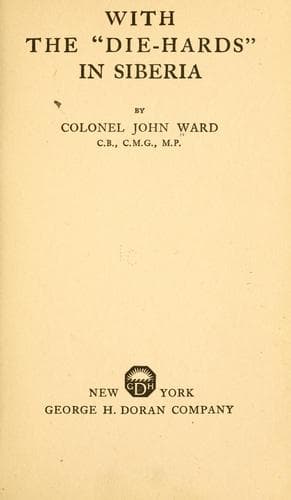
World War, 1914-1918 -- Personal narratives, English; World War, 1914-1918 -- Russia (Federation) -- Siberia
The poor, ignorant, uneducated, neglected Russian workman is perfect and
well-prepared soil for such propaganda. He found himself bound hand and
foot in the meshes of this professional element, who did not belong to
his class and, except in theory, knew nothing of his difficulties. When
this professional element had misled, bamboozled and deserted him, in a
frenzy of despair he determined to destroy this thing called education,
and made the ability to read and write one of the proofs of enmity to
his class on the same principle that our uneducated workmen of the first
half of the nineteenth century destroyed machinery and other progressive
innovations, whose purpose they did not understand. There would be less
chatter about revolution if our people could only understand what it
means to go through the horrors that have destroyed Russia and her
people more effectively than the most ruthless invasion.
We stopped at a station near a mining village largely peopled with
emigrant Chinese workmen. We removed the Bolshevik flag from the
flag-post, and insisted upon the Russian flag being run up in its stead.
A Russian woman told us to go back, and when we asked her why, she said,
"Well, it does not matter; our men will soon find enough earth to bury
you." But another Russian woman thanked us for coming, and hoped we were
not too late to save a country that was sick unto death.
That night we ran into Zema station, where we came to a sudden stop. I
sent my liaison officer to find the cause, and he informed me that a
body of men were beside the engine and threatening to shoot the driver
if he moved another foot. I ordered the "Alarm" to be sounded, and
instantly 400 British soldiers tumbled out of the trucks. Taking their
prearranged positions, they fixed bayonets and awaited orders. My
carriage was the last vehicle of the train. I walked forward to find the
cause of our enforced stoppage, and was just in time to see in the
darkness a squad of armed men leaving the station. I took possession of
the station and telegraphs, and then heard from the officials that
Bolshevik agents had come to the town and had persuaded the workmen to
leave work, to take arms and cut the line to prevent the Allies moving
forward, and await the arrival of the Bolshevik force which had retired
from Baikal. This force had worked its way along the Mongolian frontier,
and was now feeling its way towards the line to destroy the bridge which
carries the railway over the River Ocka at a point about three versts
from Zema. I placed guards around and in the railway works, engine
sheds, and approaches, and discovering telegrams still passing between
the Bolsheviks and the inhabitants, I occupied by force the post and
telegraph office in the town. Orders were issued that all men must
pledge themselves not to interfere with the trains, and return to work
by 6 A.M., or they would be dealt with under martial law. Two hours
Public-domain text, read in full here on John Shaqi.
Reviews
Reviews
No reviews yet
Be the first to share your thoughts on this work.
Join the Discussion
Join the discussion
Sign in to leave a comment or review.
Sign InorCreate an account