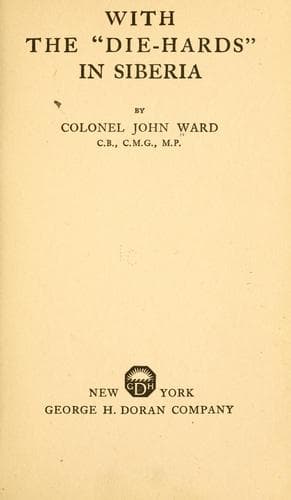
World War, 1914-1918 -- Personal narratives, English; World War, 1914-1918 -- Russia (Federation) -- Siberia
Then followed a speech by General Knox (Chief of the British Military
Mission), who implored all classes of Russian thought to pull together
to establish an Army and a Government capable of supporting law and
public order, a speech full of patriotism and very much to the point.
Then came General Bolderoff, Commander-in-Chief of the new Russian army
and military member of the Ufa Directorate. He had the appearance of a
big, brave, blundering Russian officer. Not too much brain, cunning, but
not clever. I should, however, give him credit for more than ordinary
honesty. Later Admiral Koltchak spoke--just a few short definite
sentences. Very few cheers or shouts greeted this orator. He seemed more
lonely than ever, but presented a personality that dominated the whole
gathering. There was the usual passing round and signing of menus. I
sent mine direct to the admiral for his signature, and when he
automatically passed it to General Bolderoff I said "Neat," and it was
returned with the solitary name of this solitary man. I was now
absolutely satisfied that the new Government was a combination that
refused to mix, and took the most stringent precautions to see that my
unit did not become involved in its impending overthrow. I, however,
made an important discovery at this congratulatory banquet, namely, that
Russia still had one man who was able to rescue her from anarchy.
The business of Omsk went on much as usual, but Omsk society became
more subdued in its whisperings. Clique countered clique, and
conspirators undermined conspirators, while a peculiar tension hung over
all.
During the negotiations connected with the formation of this Government
a very serious hitch occurred which at one time threatened the whole
project with disaster. General Bolderoff was known as a Social
Revolutionary in politics. Through him the Social Revolutionaries had
practically supreme control of the new army. Avkzentieff and Co., aiming
at Social Revolutionary control of all the forces of the new Government,
demanded that a Social Revolutionary should also control the
newly-organised militia, which were to act as a sort of military police
under the new régime. This was resented by the more moderate members of
both groups, as it would have practically placed all power in the hands
of one group, and that not distinguished for administrative ability or
caution. In addition to which, the very claim made the moderates
suspicious as to the use for which such power was to be employed. The
presence of the Allies and the determination to form some sort of
administration overcame these suspicions, and the moderates gave way and
left both forces under the command of the Social Revolutionary group.
Public-domain text, read in full here on John Shaqi.
Reviews
Reviews
No reviews yet
Be the first to share your thoughts on this work.
Elsewhere in the archive
Join the Discussion
Join the discussion
Sign in to leave a comment or review.
Sign InorCreate an account