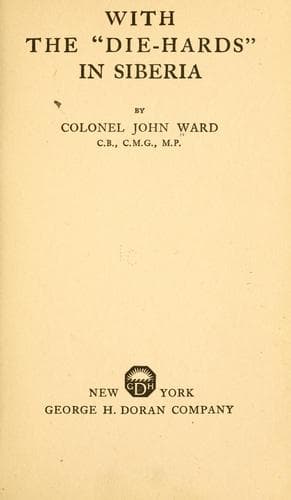
World War, 1914-1918 -- Personal narratives, English; World War, 1914-1918 -- Russia (Federation) -- Siberia
We arrived at Omsk town station at 5.30 on the evening of November 17,
1918. The admiral thanked me for my help and my guard and for the
kindness and protection I had afforded him. I promised him my continued
help and sympathy in his patriotic attempt to revive the spirit of his
people. He went straight to his lodgings and remained there.
The _Times_ correspondent in a message to his newspaper has suggested
that the admiral had prior knowledge of what was to happen that night in
Omsk. I do not think that was the case. He may have guessed that
something very unpleasant was in the wind--the least sensitive amongst
those behind the scenes knew that--but what it was, from which direction
it would come or on whom it would fall was a secret known to but very
few, and I am convinced that the admiral, except in a second degree, was
not one of them. Colonel (soon to be General) Lebediff could tell the
whole story, though his name was not even mentioned during the _coup
d'état_. A young and able Cossack officer, he was on the Staff of
Korniloff when Kerensky invited the great Cossack general to march his
army to Petrograd to save the newly-elected National Assembly. It is
well known how, when Korniloff obeyed Kerensky's order, he
treacherously turned and rent to pieces the only force which was moving
at his own request and could have saved Russia. He, in turn, became the
victim of the ghouls who urged him to this act of destruction. Lebediff
escaped, but one can be certain that he retained a lasting hate towards
the Social Revolutionaries who had betrayed his great leader.
The comrades of Kerensky, and in some cases the actual betrayers, had
found refuge in the Directorate of Five and the Council of Ministers,
and were continuing to play the same double game which had brought ruin
on the first National Assembly and disaster upon the Russian people.
They were members of the same futile crowd of useless charlatans who by
their pusillanimity had made their country a byword and the Treaty of
Brest-Litovsk possible. I was in a position to judge. I was certain that
this young man was the wrong sort to allow the execution of his chief to
pass without attempting punishment.
Public-domain text, read in full here on John Shaqi.
Reviews
Reviews
No reviews yet
Be the first to share your thoughts on this work.
Elsewhere in the archive
Join the Discussion
Join the discussion
Sign in to leave a comment or review.
Sign InorCreate an account