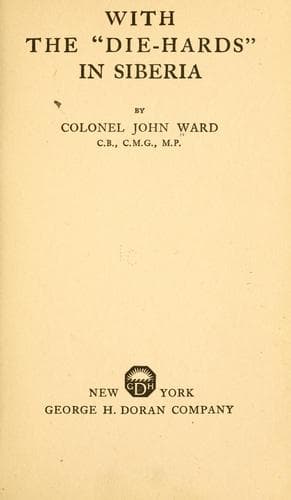
World War, 1914-1918 -- Personal narratives, English; World War, 1914-1918 -- Russia (Federation) -- Siberia
As we entered the Russian Headquarters, which were crowded with more or
less excited officers and men, my guard lined up on each side of the
vestibule, and without a word proceeded to unsling rifles and fix
bayonets. The Russians, who were even now debating on which side they
were going to slide down, looked at my soldier monks, and at once
themselves fell into line. There was no longer any hesitation. "Anglisky
soldats" were in possession of Russian Headquarters, and the reputation
of English soldiers in emergencies like this is known all over the
world. I interviewed the Chief-of-Staff, General Lebediff, as to his
orders for suppressing the revolters and went downstairs to find the
vestibule empty except for my "monks." No one who was not there could
believe the absolute transformation that the mere presence of a few
English soldiers had on this critical situation. In revolutions every
rule and safeguard of society is uprooted; the people feel as in an
earthquake, nothing is secure, everyone doubts his neighbour. If those
who are prepared to support authority can only discover at the right
moment one little group round whom they can rally, and who they know
will think nothing of death in performance of duty, the danger is over
at once. Hesitancy disappears, and the normal is instantly produced. We
filed out to find the infantry in their ranks, and the horsemen mounted
in line, under their officers, awaiting orders.
I proceeded through the town to the residence of the Supreme Governor.
On our way we passed parties of soldiers and Cossacks hurrying to their
posts, who eyed us suspiciously, but on seeing me at the head in the
uniform of a British officer, ejaculated loudly to their command the
magic word "Anglisky," until like a talisman the word passed from sentry
to sentry and street to street, and "Anglisky" became the password which
held the whole town for law and order. We passed towards the admiral's
house without challenge until the Cossack and Serbian guard at the
actual entrance called us to halt pending the governor's orders. The
order soon came for us to enter. The admiral was ill, very ill with
inflammation of the lungs, but as brave as ever. My "monks" lined up in
the vestibule in the same manner as at Headquarters, and even the
personal Serbian guard had to make way for these queer-looking visitors.
I got the information required. The revolt was very serious, but I was
able to inform the admiral that effective measures had now been taken to
provide for all eventualities. I begged leave to depart, which was
granted, but not before my men had been given food and a taste of
Russian vodka, which appears to be the only effective antidote to the
cold of a real Siberian winter. I returned, to find that the fact that
the English soldiers were out was known in every house in Omsk, and
numerous requests from the highest to the lowest for protection had been
received on the telephone. I give no names, but the fact shows what a
Public-domain text, read in full here on John Shaqi.
Reviews
Reviews
No reviews yet
Be the first to share your thoughts on this work.
Elsewhere in the archive
Join the Discussion
Join the discussion
Sign in to leave a comment or review.
Sign InorCreate an account