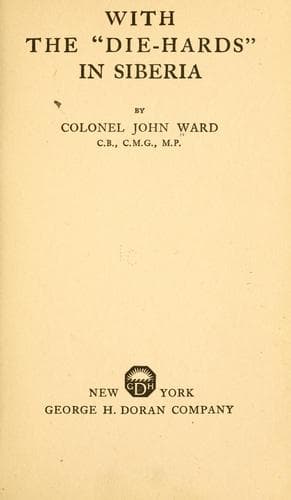
World War, 1914-1918 -- Personal narratives, English; World War, 1914-1918 -- Russia (Federation) -- Siberia
Towards the middle of January the British High Commissioner conveyed to
Admiral Koltchak an extremely sympathetic message from the British
Government. The French High Commissioner followed next day with a
similar message from the French Government, except that it distinctly
referred to the possibility of help and recognition. The Allied
representatives felt more happy and secure as a result of these
felicitations than they had done for some time, and the Russian
authorities began to feel it possible to press on with the work of
"resurrection." A new page in the history of a great recovery had been
added to Russian records. Exactly four days later a wireless message
came through from Paris to say that the Allied Council had declared that
it could give no help or recognise either side; that the different
parties and Governments existing in Russia must bring about an
armistice, and send representatives to the Turkish "Isle of Dogs," near
Constantinople, and arrange a compromise with each other. In other
words, that the Bolsheviks were to be recognised as legitimate
belligerents, with whom it was quite possible to shake hands and sit
down to draw up an agreement as to the proper method of conducting a
policy of rapine, robbery, and murder. Needless to say, every Britisher
was disgusted, and every genuine Russian patriot simply amazed. At one
swoop down went all our hopes! We were crushed as much or more than the
Russians, because we had the honour of our countries to defend, and
defence seemed impossible.
A sudden reaction against the European Allies set in at once, and became
so violent that a Russian gentleman made an abusive speech to the Allied
officers as they sipped tea in a well-known restaurant, and the public
refused to allow the guard which was called to arrest him to carry out
the order. This feeling was undoubtedly exploited by the Japanese for
their own purposes.
A very tense condition of affairs existed, when on January 31 I asked
for a special interview with Admiral Koltchak that I might introduce my
colleague and comrade, Colonel Johnson, and talk over the situation. The
admiral was out walking by the river, quite unattended, but in full view
of the guard at his residence near the river bank. It was his first walk
since his illness, and he looked quite recovered. The talk naturally
veered round to the Allied declaration in favour of the Bolsheviks and
the situation it had created in Omsk. The admiral's attitude was quite
simple. "We can talk and make compact with every party and Government in
the different districts of Russia, but to compromise with Bolshevism, or
shake the hand, or sit down and treat as equals the men who are
outraging and murdering the Russian people--never! No decent Allied
Government acquainted with the facts would ever expect it."
Public-domain text, read in full here on John Shaqi.
Reviews
Reviews
No reviews yet
Be the first to share your thoughts on this work.
Elsewhere in the archive
Join the Discussion
Join the discussion
Sign in to leave a comment or review.
Sign InorCreate an account