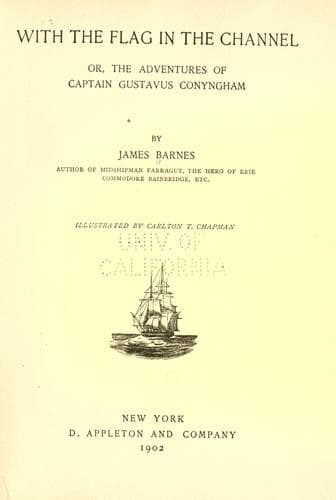
With the Flag in the Channel; or, The Adventures of Captain Gustavus ConynghamBarnes, James
History
With the Flag in the Channel; or, The Adventures of Captain Gustavus Conyngham
Barnes, James
United States -- History -- Revolution, 1775-1783 -- Juvenile fiction
It was the beginning of the second week of July, 1777, and for over a
fortnight the outfitting, loading, and changing had been going on and
the nameless vessel that was going on the nameless mission was almost
ready to set sail. To tell the truth, although at first there was some
mystery made about her ownership, her destination, and her probable
calling, there was very little of the mystery left at the time at which
this chapter opens. The English spies and sympathizers in Dunkirk were
almost at their wits’ end. They had informed their Government of
their opinions, and now began to write to the English press in order to
stir the Government to action.
A copy of the London Times almost a week old had come to the hands of
Conyngham. As he glanced through the pages, all at once his own name
attracted his attention. This had happened as he was walking down to
the wharf, and he had smiled broadly as he perused the remarkable
effusion. He had slipped the paper into his pocket, where, in the
interest of watching the vessel’s loading, although he took no active
part in its direction, he had forgotten it.
“Everything seems to be going finely, Captain Gustavus,” said Mr.
Hodge. “No one apparently suspects the ownership of the vessel, and I
do not think the French authorities will interfere with her sailing.”
Conyngham smiled. That no one seemed to object struck him as having
a humorous meaning. Perhaps he had not observed the twinkle in Mr.
Hodge’s eye, as he advanced this statement. He was about to refer to
the article in the Times when something attracted his attention.
Two men, one dressed as a sailor and the other as something of a
court dandy, came walking together down the wharf. The sailorman to
all appearances had been drinking and was asking the gentleman with
the long satin waistcoat for something more with which to quench his
thirst. At last the latter, as if he could no longer resist the man’s
importuning, reached into his pocket and, producing a purse, took out
a small silver piece. At the same time he addressed some words to the
sailor, as if bidding him begone.
“I know this fop in satin and lace,” said Hodge. “I have seen him in
Paris, but I can not recollect where. He’s not a Frenchman, but a
German or a Pole.”
“Methinks I know him too,” returned Conyngham. “He’s talking English to
that beggar. Well, well--by the great gun!--it comes to me.”
Conyngham lowered his voice almost to a whisper and spoke without
turning his head or scarcely moving his lips.
“I know both of them now,” he said. “The fop is our friend the English
spy, and the other is one of the stool-pigeons. What do you suppose
he said just then? Hush! here he comes in our direction. It is his
intention to get near to us and listen to our conversation.”
Public-domain text, read in full here on John Shaqi.
Reviews
Reviews
No reviews yet
Be the first to share your thoughts on this work.
Join the Discussion
Join the discussion
Sign in to leave a comment or review.
Sign InorCreate an account