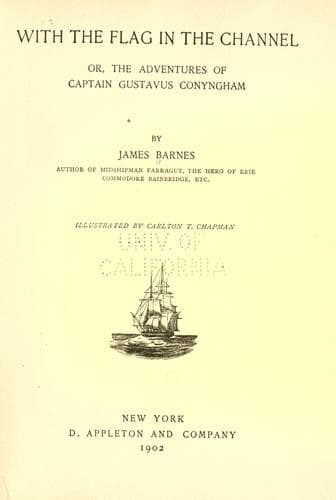
With the Flag in the Channel; or, The Adventures of Captain Gustavus ConynghamBarnes, James
History
With the Flag in the Channel; or, The Adventures of Captain Gustavus Conyngham
Barnes, James
United States -- History -- Revolution, 1775-1783 -- Juvenile fiction
“Let us move then,” suggested Mr. Hodge, “for there is a good deal
about me that I would not wish to have known; besides,” he added, “I
think you are mistaken, for I now remember where I have seen this
coxcomb, and at the house of no one less than good Dr. Bancroft, the
geographer and scientist, the friend of Franklin, and one who had kept
us well informed of the British plans.”
“Then keep an eye on Dr. Bancroft, is my advice,” rejoined Conyngham.
“Hush! let me speak to this fellow.”
The drunken sailor lurched up and leant with both elbows against a big
pine-wood box, but apparently he paid no attention to the proximity of
the others, for he began emptying his pockets of their contents, which
included the silver piece which had just been given him, and searching
for some bits of tobacco he jammed them into the bowl of his black
heavy pipe.
“What you say about the moon may be true,” observed the captain as if
carrying on some deep subject, “but still the influence of the orb upon
the tides has been acknowledged for centuries.”
The sailor by this time had found a bit of flint and steel and was
trying to ignite a bit of pocket tinder.
All at once Conyngham turned toward him, and at the same time taking
the copy of the Times out of his pocket, he spread it out on the top of
the box and began to read aloud.
“Listen to this nonsense,” he said in beginning. “The English must be
in a ferment of terror to believe such stuff as this,” and forthwith he
read:
“I saw Conyngham yesterday. He had engaged a crew of desperate
characters to man a vessel of one hundred and thirty tons. She
has now Frenchmen on board to deceive our minister here. A fine
fast-sailing vessel, handsomely painted blue and yellow, is now
at Dunkirk, having powder, small arms, and ammunition for her.
Conyngham proved the cannon himself, and told the bystanders
he would play the d----l with the British trade at Havre. It
is supposed when the vessel is ready the Frenchmen will yield
command to Conyngham and his crew. The vessel is to mount
twenty carriage-guns and to have a complement of sixty men. She
is the fastest sailer now known--no vessel can catch her once
out on the ocean.
“I send you timely notice that you may be enabled to take
active measures to stay this daring character, who fears not
man or government, but sets all at defiance.
“He had the impudence to say if he wanted provisions or
repairs, he would put into an Irish harbor and obtain them.
“It is vain here to say Conyngham is a pirate. They will tell
you he is one brave American; he is ‘a bold Boston.’
“You can not be too soon on the alert to stop the cruise of
this daring pirate.
“JAMES CLEMENTS.”
There was also a letter that Conyngham read in even a louder tone:
“PARIS, _July 28, 1777_.
Public-domain text, read in full here on John Shaqi.
Reviews
Reviews
No reviews yet
Be the first to share your thoughts on this work.
Elsewhere in the archive
Join the Discussion
Join the discussion
Sign in to leave a comment or review.
Sign InorCreate an account