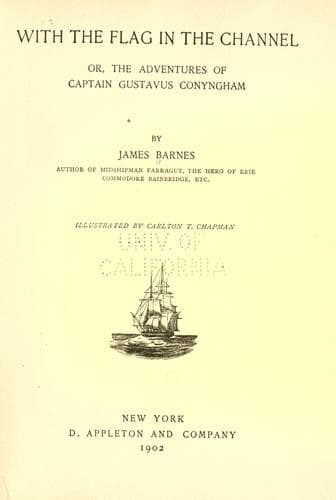
With the Flag in the Channel; or, The Adventures of Captain Gustavus ConynghamBarnes, James
History
With the Flag in the Channel; or, The Adventures of Captain Gustavus Conyngham
Barnes, James
United States -- History -- Revolution, 1775-1783 -- Juvenile fiction
“SIR: You have no doubt been informed by your ministry that
Lord Stormont had been successful, and that the Court of
Versailles had declared their ports shut against American
privateers. Let your blind politicians sleep, the guns of the
American privateers will waken them to their sorrows. The
General Mifflin privateer arrived, and Monsieur de Chauffault,
the admiral, returned the salute in form, as to a vessel from a
sovereign and independent state.
“Your papers tell us that Conyngham is in chains in Dunkirk,
and is expected shortly in London, to be tried and hung. I
tell you that Conyngham is on the ocean, like a lion searching
for prey. Woe be to those vessels who come within his grasp.
No force intimidates him. God and America is his motto. Our
country is duped by French artifice.”
As he finished it was noticeable to both men that the drunken sailor
was paying strict attention.
“What’s your opinion of that?” asked Conyngham.
The man looked up slowly and found the captain’s eyes fastened upon
his own. “I say, what is your opinion of that?” he reiterated, this
time leaning forward and grasping the man by the collar of his open
jacket.
So surprised was the latter that the pipe fell from his lips, and
before he could control himself an oath followed the pipe--an oath in
good round English.
Conyngham affected to laugh.
“Why, he has understood everything we’ve been saying,” he said, turning
to Mr. Hodge again.
The sailor, who had wrenched himself free, started to walk away. His
efforts in that direction were accelerated by a well-placed kick,
administered by the toe of Conyngham’s boot. But he apparently did not
resent it, and still affecting to be under the influence of liquor
stumbled up the wharf.
“That will puzzle our friend with the high-heeled boots,” said the
captain, “but to tell the truth I think there is very little use in any
more secrecy. They seem to know as much of the situation as we do.”
This was nothing more than the truth, and before two days had passed
Conyngham had openly acknowledged it by superintending the placing
of the cannon on board of the Revenge, and the French Government had
agreed to allow her to depart from the port of Dunkirk, upon Mr. Hodge,
who had all through the transaction appeared as her owner, signing a
bond that she would do no cruising off the coast of France.
The time of sailing drew on quickly. The vessel was laden, the
ammunition was all on board--there was no secrecy about that now--the
crew had been picked and divided into watches; some attempt had even
been made to drill them at the guns. The citizens of Dunkirk knew
almost to a man that the tidy little cruiser would soon be on the sea.
Once more the four “conspirators” were grouped about the table at the
tavern.
“Three days from now, captain, and you will be off the headlands,”
observed Mr. Hodge, “and we shall be here waiting to see which way the
cat will jump.”
Public-domain text, read in full here on John Shaqi.
Reviews
Reviews
No reviews yet
Be the first to share your thoughts on this work.
Elsewhere in the archive
Join the Discussion
Join the discussion
Sign in to leave a comment or review.
Sign InorCreate an account