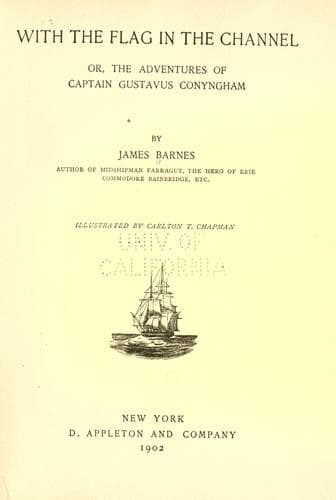
With the Flag in the Channel; or, The Adventures of Captain Gustavus ConynghamBarnes, James
History
With the Flag in the Channel; or, The Adventures of Captain Gustavus Conyngham
Barnes, James
United States -- History -- Revolution, 1775-1783 -- Juvenile fiction
All this time Conyngham was planning to escape. Not an opportunity went
by that he did not seize upon to extend his plans. After his being
remanded on the high-treason charge, strange to say, his treatment
improved and he was allowed the liberty of the jail-yard, and found
opportunity on one or two occasions to converse with some of his
fellow prisoners. Many of them were Frenchmen, who had been taken
in the actions with the French fleet. On one occasion a battle was
fought within hearing of Plymouth, and the soldiers and inhabitants,
fearing that the French were going to attempt to land, began to throw
up earthworks and entrenchments along the water front. Among the
prisoners that were brought in was a Frenchman who had served in the
capacity of surgeon on one of the captured vessels. He was a man of
education, and his clothes were of a better character and texture than
those of the other prisoners, who were mostly common seamen. He spoke
no English, however, and Conyngham had to talk with him in French. Now
it happened that the prison doctor, who made his round of visits every
day, was a short, slight man, something of the young captain’s general
build and appearance. The clothes he wore were black, and he usually
carried a book under his arm in which he kept a record of his patients
and their condition. It suggested itself to Conyngham that it might be
easy for the Frenchman so to disguise himself that he might be taken
for the doctor, and by walking out boldly past the sentries in the
evening gain the outside of the prison walls and conceal himself in the
town.
“All you need,” Conyngham observed, speaking in French, “is a pair of
huge horn spectacles, pull your hat well down over your eyes, and walk
out of the door. I’ve studied the doctor’s gait--he walks like this----”
Suiting the action to the word, Conyngham gave a very good imitation of
the English doctor’s mincing step. The Frenchman laughed.
“My faith!” he exclaimed, “it is it to the life! I have observed him.
But remember this, my friend; I speak no English and would be helpless;
they would discover me at once.”
A day or so later the Frenchman and Conyngham met again in the
jail-yard. The latter motioned his friend aside to where one of the
stone buttresses hid them from the sight of the sentry who was
watching the yard.
“Here,” said the captain; “with this wire I have made a pair of
spectacles, and in the evening no one would notice that there is not
glass inside the rims.”
As he spoke he placed the wire upon his nose, drew down his upper lip,
and the Frenchman looked at him and laughed.
“My faith!” he said again, “it is the doctor to the life.” And then,
as if an idea had suddenly dawned upon him, he touched Conyngham on
the shoulder. “It is you who should try it,” he said. “You shall have
my clothes. I can give them to you piece by piece, and as they have
allowed me to keep some others I shall not miss them.”
Public-domain text, read in full here on John Shaqi.
Reviews
Reviews
No reviews yet
Be the first to share your thoughts on this work.
Elsewhere in the archive
Join the Discussion
Join the discussion
Sign in to leave a comment or review.
Sign InorCreate an account