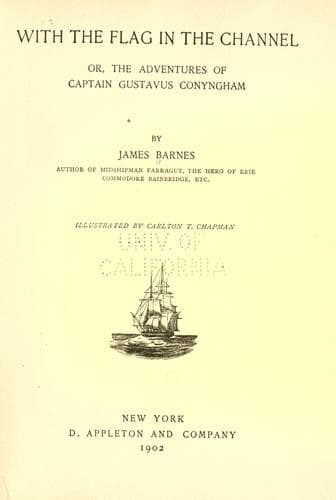
With the Flag in the Channel; or, The Adventures of Captain Gustavus ConynghamBarnes, James
History
With the Flag in the Channel; or, The Adventures of Captain Gustavus Conyngham
Barnes, James
United States -- History -- Revolution, 1775-1783 -- Juvenile fiction
[Illustration: One after another the men were pulled forth.]
By common consent they were to divide into small parties and make their
way to London or the vicinity, where from their various hiding-places
they were to inform a certain Mr. Digges of their arrival. It would be
six hours and more before their escape would be discovered.
One by one, keeping close to the cover of the walls, they each made
the shelter of a small clump of bushes, from which they reached a wood
about a half mile distant, where a meeting was held to determine on
their future course of action. It was a very short one, for Conyngham
dominated it and impressed upon them the necessity for haste. Soon all
were on the highroad, which they followed for about five miles and
then broke up in small parties as had been arranged for. Strange to
say, only fourteen of them, so far as could be ascertained, were ever
recaptured. The fat boy escaped!
Conyngham and one of the officers were the first to reach London, where
they immediately repaired to the house of Mr. Digges, who provided them
with food, money, and clothing, and despite the great risk began to
make preparations to assist the other men as they should arrive.
Conyngham, while walking the streets of London, had the pleasure of
seeing displayed, in the window of a print-shop, a most extravagant
print alleged to be his portrait, “representing him a man of gigantic
stature, very broad in the shoulders, the whole person indicating great
strength, with a ferocious countenance. Under the arm was a sword at
least six feet long, and beneath the whole was the legend, ‘The Yankee
Pirate, Conyngham, the arch-rebel. An Admirable likeness.’”
Soon a vessel was found that was sailing for Amsterdam, and on board of
her Conyngham embarked in the guise of an English merchant, but before
this, six of his companions had made their way to the seacoast, where
they had helped themselves to a small fishing boat and arrived safely
on the French coast. As soon as he reached Amsterdam he wrote the
letter to Benjamin Franklin which we quoted at the beginning of this
chapter.
John Paul Jones was then in the Texel, where he was having any amount
of trouble with the Dutch authorities owing to the objections of
the English representatives to his remaining there with his prizes.
Conyngham joined him, when at last he was forced to leave, and sailed
with him in the Alliance; but the captain’s misfortunes were not yet
over.
CHAPTER XVIII
CONCLUSION
The Alliance put into Corunna, where Conyngham saw again
representatives of the house of Roderigo, Hortalez and Company, and
learned that the money received for the prizes had been forwarded to
the commissioner’s agent at Paris.
Public-domain text, read in full here on John Shaqi.
Reviews
Reviews
No reviews yet
Be the first to share your thoughts on this work.
Elsewhere in the archive
Join the Discussion
Join the discussion
Sign in to leave a comment or review.
Sign InorCreate an account