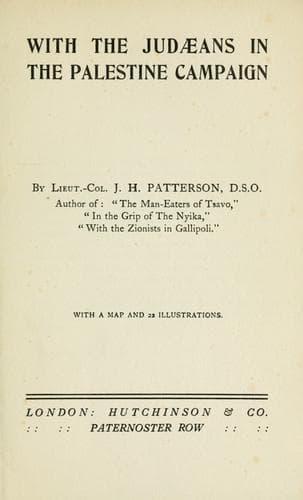
With the Judæans in the Palestine CampaignPatterson, J. H. (John Henry)
History
With the Judæans in the Palestine Campaign
Patterson, J. H. (John Henry)
World War, 1914-1918 -- Campaigns -- Palestine; World War, 1914-1918 -- Participation, Jewish
On arrival the General apologised to the insulted men, but so indignant
were they that at first they refused to accept it, or to shake hands
when he offered to do so. Finally, after over half-an-hour's persuasion,
they agreed to accept his apology, provided it was given publicity, and
also to the whole battalion on parade. This he did very fully, and I
sincerely hoped that the incident was happily ended, and that for the
future, in dealing with us, General Z would see that no injustice was
done merely because we were Jews.
To compensate for all the misfortunes we were called upon to endure, our
life in the battalion itself was quite smooth and happy, all pulling
well together.
Personally, I took no thought whether a man was a Jew or a Gentile; I
remember that an officer joined us while we were serving at the front,
and, through some misunderstanding, I took him to be a Jewish officer.
He distinguished himself later and earned the M.C., which pleased me
very much, for I was always glad when I was able to recommend a Jewish
officer for promotion or reward. I sent this officer with nine others to
form a "Minyan" (the number required to hold a Jewish religious service)
at the burial of a Jewish soldier who was killed on the day we captured
the Umm esh Shert Ford, and it was not until after this incident
happened that I discovered he was a Gentile.
There was one exception, however, to the general harmony and _esprit de
corps_ of the battalion. A Staff officer was sent to do duty with us
from G.H.Q., where he had been employed for over a year. Some time after
his arrival he publicly insulted one of my Jewish officers and refused
to apologise. The matter was then brought before me, and, as he still
remained obdurate, I brought him before General Z. When asked by the
latter why he had insulted the Jewish officer his reply was, "I don't
like Jews. _The Jews are not liked at G.H.Q., and you know it, Sir."_
The General ordered him to apologise, which I must say he did most
handsomely, but his remarks about the dislike of Jews at G.H.Q., though
no news to me or the General, may be somewhat illuminating to the
reader!
Although we hoped that all unpleasantness with the General was over, I
regret to say that this was not the case. I could give many instances of
unfair treatment to which we were subjected, but I will not weary the
reader by relating them here. After his apology the General never again
came near us, and every indignity, slight and petty tyranny that could
be invented was put upon the battalion. The whole subsequent attitude of
the G.O.C. showed us that his apology was merely eye-wash, and had
simply been extracted from him by fear of the consequences of his
outrageous behaviour.
In fact, in the end, I had to bring his conduct to the notice of the
Commander-in-Chief, with the result that he was removed from his Command
and no longer troubled Israel.
CHAPTER XXXI.
PROTESTS.
Public-domain text, read in full here on John Shaqi.
Reviews
Reviews
No reviews yet
Be the first to share your thoughts on this work.
Elsewhere in the archive
Join the Discussion
Join the discussion
Sign in to leave a comment or review.
Sign InorCreate an account