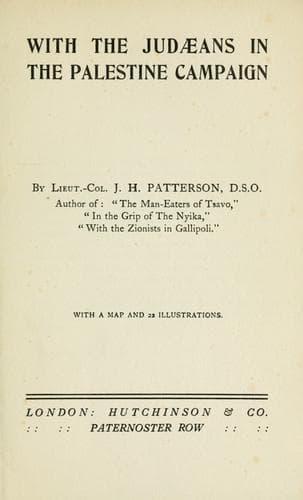
With the Judæans in the Palestine CampaignPatterson, J. H. (John Henry)
History
With the Judæans in the Palestine Campaign
Patterson, J. H. (John Henry)
World War, 1914-1918 -- Campaigns -- Palestine; World War, 1914-1918 -- Participation, Jewish
Jewish brains, Jewish capital, and Jewish workers will undoubtedly
carry out this scheme, and gradually the country, which is now arid and
neglected, will be turned once more into a land flowing with milk and
honey. The hills will again be terraced and crowned with fig and olive
trees, and the valleys and plains will abound with ripening corn.
The country which for hundreds of years has been at a standstill, lends
itself to all kinds of industrial enterprises, such as fruit-farming,
olive oil and soap factories, fishing and canning, etc.
The trade and commerce that will flow through Palestine is not to be
measured by the paltry revenue returns now shown. When the country is
developed, the old trade routes with the hinterland reopened, and the
ports at Haifa and Jaffa improved, its importance, commercially, will be
enhanced beyond all recognition.
CHAPTER XXXIII.
STRANGE METHODS OF THE E.E.F. STAFF.
It will be remembered that Lieutenant Jabotinsky was responsible for the
idea of forming a Jewish Legion to help England in her great struggle
for world freedom.
The British Government was impressed with the possibilities he placed
before it, and eventually he was summoned to the War Office by Lord
Derby, then Secretary of State for War, and to the War Cabinet by
General Smuts, to expound his proposals. These high officials did not
disdain to meet and confer with Jabotinsky on the Jewish Legion
question, although at that time he was merely a private soldier, serving
in the 20th Battalion of the London Regiment. They knew that he held a
very high place in the Zionist movement, and was looked up to by the
Jewish masses the world over as one of its most brilliant young leaders.
This fact was also known to the Staff of the E.E.F., but when, as an
officer, in August, 1919, Lieutenant Jabotinsky sought an interview with
the Commander-in-Chief, hoping that he might induce the local
authorities to change their anti-Jewish policy in Palestine, he was not
only refused a hearing, but methods were immediately employed to strike
him down which I can only describe as despicable and un-English.
Jabotinsky was, of course, pro-British to the core. During his service
in Palestine he had been for a time specially attached to the Zionist
Commission with the sanction of the Commander-in-Chief. While he was
employed in this capacity he brought about the acceptance of a programme
by the Jewish Colonists, expressly calling for a British Mandate for
Palestine.
All through his military service with the Battalion he, to my personal
knowledge, did his utmost to allay the feelings of resentment felt by
the Jewish soldiers at the bad treatment they received at the hands of
the military authorities, treatment utterly undeserved and uncalled for,
but apparently deliberately adopted to further what appeared to be the
local policy of making the practical application of the Balfour
Declaration an impossibility.
Public-domain text, read in full here on John Shaqi.
Reviews
Reviews
No reviews yet
Be the first to share your thoughts on this work.
Elsewhere in the archive
Join the Discussion
Join the discussion
Sign in to leave a comment or review.
Sign InorCreate an account