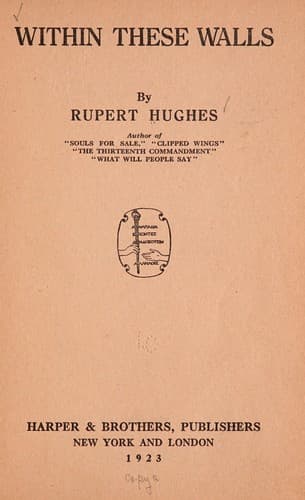
Families -- Fiction; Man-woman relationships -- Fiction; New York (N.Y.) -- History -- 19th century -- Fiction
The Charleston _Mercury_ proclaimed: “This is War.” New York bankers
and merchants realized that they must, then, assume the chief burden of
furnishing men, munitions, and money.
RoBards’ heart sank within him. The great war had found him fifty-five
years old. He would never get to a war, never fight for his country.
But Patty’s heart leaped like a doe startled from a covert. It leaped
with a cry:
“My boy is in the first regiment that will go!”
CHAPTER XLV
The forty million Africans who had been raped from the Dark Continent
and distributed among the Christian nations at so much per head, had
made little active resistance to being swallowed, but had proved hard
to digest. The missionary movements just begun had made little progress
in Africa and some thought it an advantage to bring the Africans to
the country where they could have the benefits of training in the
true religion. But this training had a little too much to do with an
education in the arts of bloodhounds, in the vigor of overseers’ whips
and in the dramatic experiences of the auction block.
This transplanted race threw off such myriads of mulattoes, quadroons
and octoroons that the situation had social complications: involving
the future life as well as this. While most of the Americans were
undoubtedly going to hell, those who were going to heaven were not
comfortable at the prospect of flying around with black saints whose
haloes might get caught in their kinky hair. People were saying that
America “could not exist half black and half white”; some doubted if
even heaven could exist half black and half white.
The pestiferous abolitionists had survived mobs, courts, and the horror
of being unfashionable. Even the churches could not keep infidels in
their congregations from questioning the manifest will of God, who in
Mosaic law had imposed and regulated slavery, and in the New Testament
had commanded the return of a runaway slave. Numerous individual
clergymen had taken a conspicuous part in this form of sacrilege,
but the great majority were true to their creeds, and denounced the
heretics. The Methodist and other churches in official assemblies
repeatedly disciplined their anarchic parsons and forbade the attempt
to stir up useless hostility by advocating “emancipation.” But the
trouble-mongers would not be quieted. In spite of the efforts of the
respectables, there was, as one New York writer put it, a “lamentable
squandering of vast sums of money in an improbable and visionary
crusade, which might have conferred inestimable benefits had they not
been diverted from the legitimate channels of Christian benevolence.”
Public-domain text, read in full here on John Shaqi.
Reviews
Reviews
No reviews yet
Be the first to share your thoughts on this work.
Elsewhere in the archive
Join the Discussion
Join the discussion
Sign in to leave a comment or review.
Sign InorCreate an account