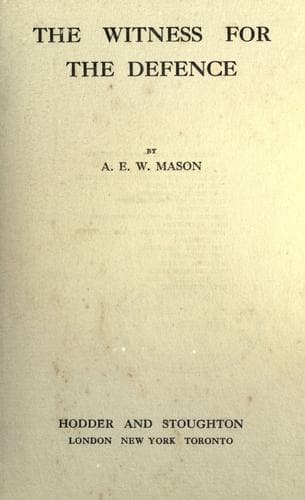
Witness for the DefenceMason, A. E. W. (Alfred Edward Woodley)
General
Witness for the Defence
Mason, A. E. W. (Alfred Edward Woodley)
Historical fiction; Legal stories
"'Mrs. Ballantyne then turned very pale, and running after me down the
garden like a distracted woman cried: "Why did you tell him to do that?
It will some night mean my death."' This statement, Mr. Thresk, was
elicited in cross-examination by Mrs. Ballantyne's counsel, and it could
only mean that he intended to set up a plea of self-defence. I find it a
little difficult to reconcile that intention with the story you
subsequently told."
Henry Thresk for his part knew that it was not merely difficult, it was,
in fact, impossible. Mr. Pettifer had read the evidence with an accurate
discrimination. The plea of self-defence was here foreshadowed and it was
just the certainty that the defence was going to rely upon it for a
verdict which had brought Henry Thresk himself into the witness-box at
Bombay. Given all that was known of Stephen Ballantyne and of the life he
had led his unhappy wife, the defence would have been a good one, but for
a single fact--the discovery of Ballantyne's body outside the tent. No
plea of self-defence could safely be left to cover that. Thresk himself
wondered at it. It struck at public sympathy, it seemed the act of a
person insensate and vindictive. Therefore he had come forward with his
story. But Mr. Pettifer was not to know it.
"There are three things for you to remember," said Thresk. "In the first
place it is too early to assume that self-defence was going to be the
plea. Assumptions in a case of this kind are very dangerous, Mr.
Pettifer. They may lead to an irreparable injustice. We must keep to the
fact that no plea of self-defence was ever formulated. In the second
place Mrs. Ballantyne was brought down to Bombay in a state of complete
collapse. Her married life had been a torture to her. She broke down at
the end of it. She was indifferent to anything that might happen."
Pettifer nodded. "Yes, I can understand that."
"It followed that her advisers had to act upon their own initiative."
"And the third point?" Pettifer asked.
"Well, it's not so much a point as an opinion of mine. But I hold it
strongly. Her counsel mishandled the case."
Pettifer pursed up his lips and grunted. He tapped a finger once or twice
on the table in front of him. He looked towards Thresk as if all was not
quite said. Harold Hazlewood, to whom the position of a neglected
listener was rare and unpalatable, saw an opportunity for intervention.
"The three points are perhaps not very conclusive," he said.
Thresk turned towards him coldly:
"I promised to answer such questions as Mr. Pettifer put to me. I am
doing that. I did not undertake to discuss the value of my answers
afterwards."
"No, no, quite so," murmured Mr. Hazlewood. "We are very grateful, I am
sure," and he left once more the argument to Pettifer.
"Then I come to the next question, Mr. Thresk. At some moment in this
inquiry you of your own account put yourself into communication with Mrs.
Ballantyne's advisers and volunteered your evidence?"
"Yes."
Public-domain text, read in full here on John Shaqi.
Reviews
Reviews
No reviews yet
Be the first to share your thoughts on this work.
Elsewhere in the archive
Join the Discussion
Join the discussion
Sign in to leave a comment or review.
Sign InorCreate an account