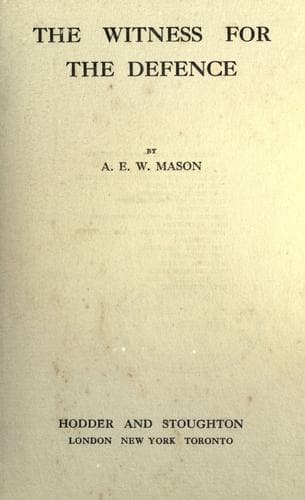
Witness for the DefenceMason, A. E. W. (Alfred Edward Woodley)
General
Witness for the Defence
Mason, A. E. W. (Alfred Edward Woodley)
Historical fiction; Legal stories
She went along the path and across the meadow. Thresk watched her go and
saw the light spring up in her room. Then he closed the window and drew
the curtain. Mr. Hazlewood had gone. Thresk wondered what the morrow
would bring. After all, Stella was right. Youth was a graceful thing of
high-sounding words and impetuous thoughts, but like many other graceful
things it could be hard and cruel. Its generosity did not come from any
wide outlook on a world where there is a good deal to be said for
everything. It was rather a matter of physical health than judgment. Yes,
he was glad Dick Hazlewood was half his way through the thirties. For
himself--well, he knew his business. It was to be kind. He turned off the
lights and went to bed.
CHAPTER XXVII
THE VERDICT
"Six, seven, eight," said Mr. Hazlewood, counting the letters which he
had already written since breakfast and placing them on the salver which
Hubbard was holding out to him. He was a very different man this morning
from the Mr. Hazlewood of yesterday. He shone, complacent and serene. He
leaned back in his chair and gazed mildly at the butler. "There must be
an answer to the problem which I put to you, Hubbard."
Hubbard wrinkled his brows in thought and succeeded only in looking a
hundred and ten years old. He had the melancholy look of a moulting bird.
He shook his head and drooped.
"No doubt, sir," he said.
"But as far as you are concerned," Mr. Hazlewood continued briskly, "you
can throw no light upon it?"
"Not a glimmer, sir."
Mr. Hazlewood was disappointed and with him disappointment was petulance.
"That is unlike you, Hubbard," he said, "for sometimes after I have been
deliberating for days over some curious and perplexing conundrum, you
have solved it the moment it has been put to you."
Hubbard drooped still lower. He began the droop as a bow of
acknowledgment but forgot to raise his head again.
"It is very good of you, sir," he said. He seemed oppressed by the
goodness of Mr. Hazlewood.
"Yet you are not clever, Hubbard! Not at all clever."
"No, sir. I know my place," returned the butler, and Mr. Hazlewood
continued with a little envy.
"You must have some wonderful gift of insight which guides you straight
to the inner meaning of things."
"It's just common-sense, sir," said Hubbard.
"But I haven't got it," cried Mr. Hazlewood. "How's that?"
"You don't need it, sir. You are a gentleman," Hubbard replied, and
carried the letters to the door. There, however, he stopped. "I beg your
pardon, sir," he said, "but a new parcel of _The Prison Walls_ has
arrived this morning. Shall I unpack it?"
Mr. Hazlewood frowned and scratched his ear.
"Well--er--no, Hubbard--no," he said with a trifle of discomfort. "I am
not sure indeed that _The Prison Walls_ is not almost one of my mistakes.
We all make mistakes, Hubbard. I think you shall burn that parcel,
Hubbard--somewhere where it won't be noticed."
Public-domain text, read in full here on John Shaqi.
Reviews
Reviews
No reviews yet
Be the first to share your thoughts on this work.
Elsewhere in the archive
Join the Discussion
Join the discussion
Sign in to leave a comment or review.
Sign InorCreate an account