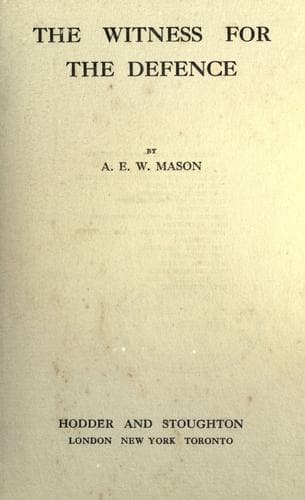
Witness for the DefenceMason, A. E. W. (Alfred Edward Woodley)
General
Witness for the Defence
Mason, A. E. W. (Alfred Edward Woodley)
Historical fiction; Legal stories
He appeared a few minutes afterwards fresh from his ride, glowing with
good-humour and contentment. But the sight of Thresk surprised him.
"Hulloa," he cried. "Good-morning. I thought you were going to catch the
eight forty-five."
"I felt lazy," answered Thresk. "I sent off some telegrams to put off my
engagements."
"Good," said Dick, and he sat down at the breakfast-table. As he poured
out a cup of tea, Thresk said:
"I think I heard you were over thirty."
"Yes."
"Thirty's a good age," said Thresk.
"It looks back on youth," answered Dick.
"That's just what I mean," remarked Thresk. "Do you mind a cigarette?"
"Not at all."
Thresk smoked and while he smoked he talked, not carelessly yet careful
not to emphasize his case. "Youth is a graceful thing of high-sounding
words and impetuous thoughts, but like many other graceful things it can
be very hard and very cruel."
Dick Hazlewood looked closely and quickly at his companion. But he
answered casually:
"It is supposed to be generous."
"And it is--to itself," replied Thresk. "Generous when its sympathies are
enlisted, generous so long as all goes well with it: generous because it
is confident of triumph. But its generosity is not a matter of judgment.
It does not come from any wide outlook upon a world where there is a good
deal to be said for everything. It is a matter of physical health."
"Yes?" said Dick.
"And once affronted, once hurt, youth finds it difficult to forgive."
So far both men had been debating on an abstract topic without any
immediate application to themselves. But now Dick leaned across the table
with a smile upon his face which Thresk did not understand.
"And why do you say this to me this morning, Mr. Thresk?" he asked
pointedly.
"Yes, it's rather an impertinence, isn't it?" Thresk agreed. "But I was
looking into a case late last night in which irrevocable and terrible
things are going to happen if there is not forgiveness."
Dick took his cigarette-case from his pocket.
"I see," he remarked, and struck a match. Both men rose from the table
and at the door Dick turned.
"Your case, of course, has not yet come on," he said.
"No," answered Thresk, "but it will very soon."
They went into the library, and Mr. Hazlewood greeted his son with a
vivacity which for weeks had been absent from his demeanour.
"Did you ride this morning?" he asked.
"Yes, but Stella didn't. She sent word over that she was tired. I must go
across and see how she is."
Mr. Hazlewood interposed quickly:
"There is no need of that, my boy; she is coming here this morning."
"Oh!"
Dick looked at his father in astonishment.
"She said no word of it to me last night--and I saw her home. I suppose
she sent word over about that too?"
He looked from one to the other of his companions, but neither answered
him. Some uneasiness indeed was apparent in them both.
Public-domain text, read in full here on John Shaqi.
Reviews
Reviews
No reviews yet
Be the first to share your thoughts on this work.
Elsewhere in the archive
Join the Discussion
Join the discussion
Sign in to leave a comment or review.
Sign InorCreate an account