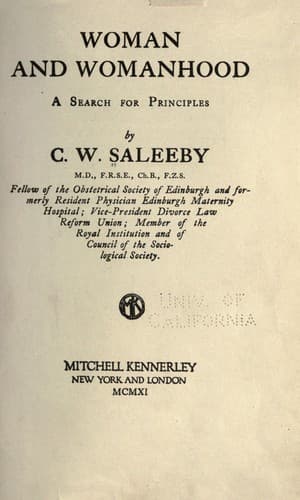
Woman and Womanhood: A Search for PrinciplesSaleeby, C. W. (Caleb Williams)
Science
Woman and Womanhood: A Search for Principles
Saleeby, C. W. (Caleb Williams)
Eugenics; Women
To begin with what is perhaps the oldest of these, though indeed
scarcely entitled to the appellation of popular, let us assure ourselves
once and for all that we are talking about a fact natural, innate, not
acquired. The modern criticism of ancient notions of human nature, such
as those expressed in the theologians' conception of "conscience," has
inclined some to the view that our best feelings are indeed not at all
innate. No one can for a moment analyze conscience without observing the
immense disparity between the facts and the theologians' theory. And
thus we are apt to fall into the opposite error of supposing that our
impulses towards good action are entirely the products of education,
training, public opinion, and so forth. Let the reader refer, for
instance, to such a celebrated work as John Stuart Mill's
"Utilitarianism," and it will be seen how wide of the mark it was
possible for even a great thinker to go, when his ideas of mind were
unguided by the light of evolution. Even in the greatest writer of that
time not a syllable do we find as to the parental instinct. "As is my
own belief," says Mill, "the moral feelings are not innate but
acquired." Yet we have seen convincing evidence which teaches us that
the moral feelings spring essentially from the root of the parental
instinct, without which mankind could not continue for another
generation, and than which there is nothing more fundamental and
essential in any type of human nature that can persist.
The importance of noting this can be clearly stated. We are here dealing
with something which is not for us to implant, but which is already part
of the plant, so to speak, and which it is for us to tend. Like other
innate features of mankind, its transmission from generation to
generation is notably independent of the effects of education, the
effects of use and disuse. This is a difficult thing of which to
persuade people, but it is the fact. Education, environment, training,
opportunity, habit, public opinion, social prejudice--all these and
such other influences may and do affect the maternal instinct in the
individual for good or for evil. No fact is more certain or important,
and that is precisely why we must study this instinct. But the effect
upon the individual does not involve any effect upon the native
constitution of the individual's children. From age to age the general
facts and features of the human backbone persist. We do not expect to
find notable differences between the generations in such a radical
feature of our constitution, no matter what particular habits of
posture, play, and the like we adopt. The maternal instinct is scarcely
less fundamental; it is certainly no whit less essential for the
species. It is the very backbone of our psychological constitution. Thus
it is nonsense to assert that, for instance, women are becoming less
motherly, if by this is meant that the maternal instinct is failing.
Public-domain text, read in full here on John Shaqi.
Reviews
Reviews
No reviews yet
Be the first to share your thoughts on this work.
Elsewhere in the archive
Join the Discussion
Join the discussion
Sign in to leave a comment or review.
Sign InorCreate an account