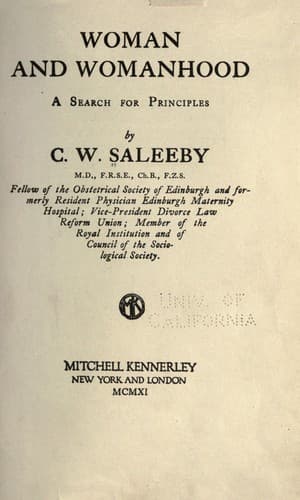
Woman and Womanhood: A Search for PrinciplesSaleeby, C. W. (Caleb Williams)
Science
Woman and Womanhood: A Search for Principles
Saleeby, C. W. (Caleb Williams)
Eugenics; Women
What, then, is it in our power to do; and how are we to do it? It may be
argued that if the maternal instinct is a thing which cannot be made or
acquired, our study of it has little relation to practice. But indeed it
is eminently practical.
For, in the first place, this priceless possession, this parental
instinct and tenderness, is inheritable. We know by observation amongst
ourselves that hardness and tenderness are to be found running through
families--are things which are transmissible. Let us, then, make
parenthood the most responsible, the most deliberate, the most
self-conscious thing in life, so that there shall be children born to
those who love children, and only to those who love children, to those
who have the parental instinct naturally strong, and who will, on the
average, transmit a high measure of it to their offspring. In a
generation bred on these principles--a generation consisting only of
babies who were loved before they were born--there would be a proportion
of sympathy, of tender feeling, and of all those great, abstract,
world-creating passions which are evolved from the tender emotion, such
as no age hitherto has seen.
It was necessary to insert this eugenic paragraph because it expresses
the central principle of all real reform, as fundamental and
all-important as it is unknown to all political parties, and I fear to
nearly all philanthropists as well. But, for the present, our immediate
concern is the application, if such be possible, of our knowledge of the
parental instinct to the education of girls. Being indeed an instinct it
can be neither made nor acquired, but, like every other factor of
humanity that is given by inheritance, it depends upon the conditions in
which it finds itself. Education being the provision of an environment,
there is no higher task for the educator than to provide the right
environment for the maternal instinct in adolescence. We are to look
upon it as at once delicate and ineradicable. These are adjectives which
may seem incompatible, yet they may both be verified. Any one will
testify that, in a given environment, say that of high school or
university or that of the worst types of what is called society, the
maternal instinct may then and there, and for that period, become a
nonentity in many a girl. Hence we are entitled to say that it is
delicate; much more delicate, for instance, than what we have agreed to
call the racial instinct, which is far more imperious and by no means so
easily to be suppressed.
Public-domain text, read in full here on John Shaqi.
Reviews
Reviews
No reviews yet
Be the first to share your thoughts on this work.
Elsewhere in the archive
Join the Discussion
Join the discussion
Sign in to leave a comment or review.
Sign InorCreate an account